ABA Number: Full Form, Example & How It Works (2026)

TL;DR - Summary
- What is an ABA number? - It is a nine-digit code that identifies a specific financial institution in the United States for domestic money transfers. The American Bankers Association created this system to help banks process paper checks and electronic payments accurately.
- Why is an ABA number essential? - An ABA number is like a financial institution's address. Based on ABA numbers, automated systems clear electronic transfers and paper check payments without manual intervention.
- When should you share an ABA number with your US client? - You only need to share an ABA number with your client when you have a US virtual account. Your clients can pay you via local transfer methods like ACH or Fedwire into these accounts.
- What is the format of an ABA routing number? - An ABA number has exactly nine digits with no letters or special characters. The digits represent the bank's location, the Federal Reserve bank handling the transfer, and a checksum digit for validation.
- Where can I find my bank's ABA number? - You can find this number in the bottom-left corner of a physical check, your online banking dashboard, or your monthly bank statement. For virtual accounts, your payment platform provides these details in your account profile.
What Is an ABA Number?
An ABA number is a nine-digit code that identifies financial institutions in the United States. ABA stands for American Bankers Association (ABA), which introduced this numbering system in 1910 to organize the processing of paper checks.
The other name for ABA number is Routing Transit Number (RTN). As banks use it to route money through paper checks, direct deposits, wire transfers, and ACH payments to the correct destination during domestic transactions.
There are approximately 22,000 active ABA routing numbers in circulation. The Federal Reserve decides which banks get an ABA number and gain access to the payment system. While LexisNexis Risk Solutions works as the registrar, taking care of new applications and keeping the routing number database up-to-date.
A single bank often has more than one ABA number. They use different ABA numbers for different regions or specific types of transactions, like electronic ACH payments versus paper check clearing. ABA numbers are for US domestic transfers only. For international transactions, banks use SWIFT/BIC codes or IBANs.
Why are ABA Numbers Essential?
ABA numbers are essential because they ensure money moving through the US banking system reaches the right bank without errors. It’s like a precise address for a financial institution. Without an ABA number, it’s hard to identify banks; relying on bank names is not foolproof, as many banks have identical names.
Accuracy is the primary benefit of the ABA system. When a sender provides an ABA number, it directs the funds to the specific Federal Reserve district and the exact bank branch intended. This prevents payments from being lost or delayed. Automated systems read these numbers to clear electronic funds and paper checks rapidly, without manual intervention by bank staff.
Several financial operations rely on ABA numbers. These include payroll direct deposits, government tax refunds, recurring bill payments, and ACH electronic transfers.
Direct deposits: Private companies and government agencies use direct deposit to pay salaries and benefits directly into their employees’ accounts
ACH and wire transfers: In 2025, the ACH network processed over $80+ trillion across tens of billions of domestic electronic payments using ABA routing numbers.
In physical checks, the ABA number is printed in Magnetic Ink Character Recognition (MICR) font. High-speed sorting machines read the bank information through this specialized ink instantly. It also enables mobile banking features, such as depositing a check by taking a photo with a smartphone.

When would an Indian Freelancer or Exporter need to use an ABA Number?
An Indian freelancer or exporter needs an ABA number when they’re using a US-based virtual collection account to receive payments. They can share local banking details with their US clients to get paid much faster. An ABA number is unnecessary if they use other payment methods like SWIFT or PayPal.
Virtual Account (ABA Number Needed)
For a standard international wire transfer, you do not use an ABA number. Instead, you share your Indian bank’s SWIFT/BIC code and IFSC code. Your client initiates an international transfer through their bank, which moves the money through the global SWIFT network.
Sometimes, a US intermediary bank involved in a SWIFT transfer might use an ABA code internally to move the money within the US. You have no role to play here.
Direct SWIFT Wire (No ABA Number Needed)
For a standard international wire transfer, you do not use an ABA number. Instead, you share your Indian bank’s SWIFT/BIC code and IFSC code. Your client initiates an international transfer through their bank, which moves the money through the global SWIFT network.
Sometimes, a US intermediary bank involved in a SWIFT transfer might use an ABA code internally to move the money within the US. You have no role to play here.
PayPal / Marketplaces (No ABA Number Needed)
PayPal and most online marketplaces do not require an ABA number for settling payments. They use closed-loop digital wallets where your transactions are tied to an email address, or a linked bank card.
PayPal handles the internal currency settlement and pushes the funds to your mapped Indian bank account through local channels.
What Does an ABA Number Look Like? ABA Format and Examples
An ABA number is always exactly nine digits long. It contains only numbers and does not include letters or special characters. If your client shares a 10-digit code, you can politely push back by saying US banks only use 9-digit transit routers.
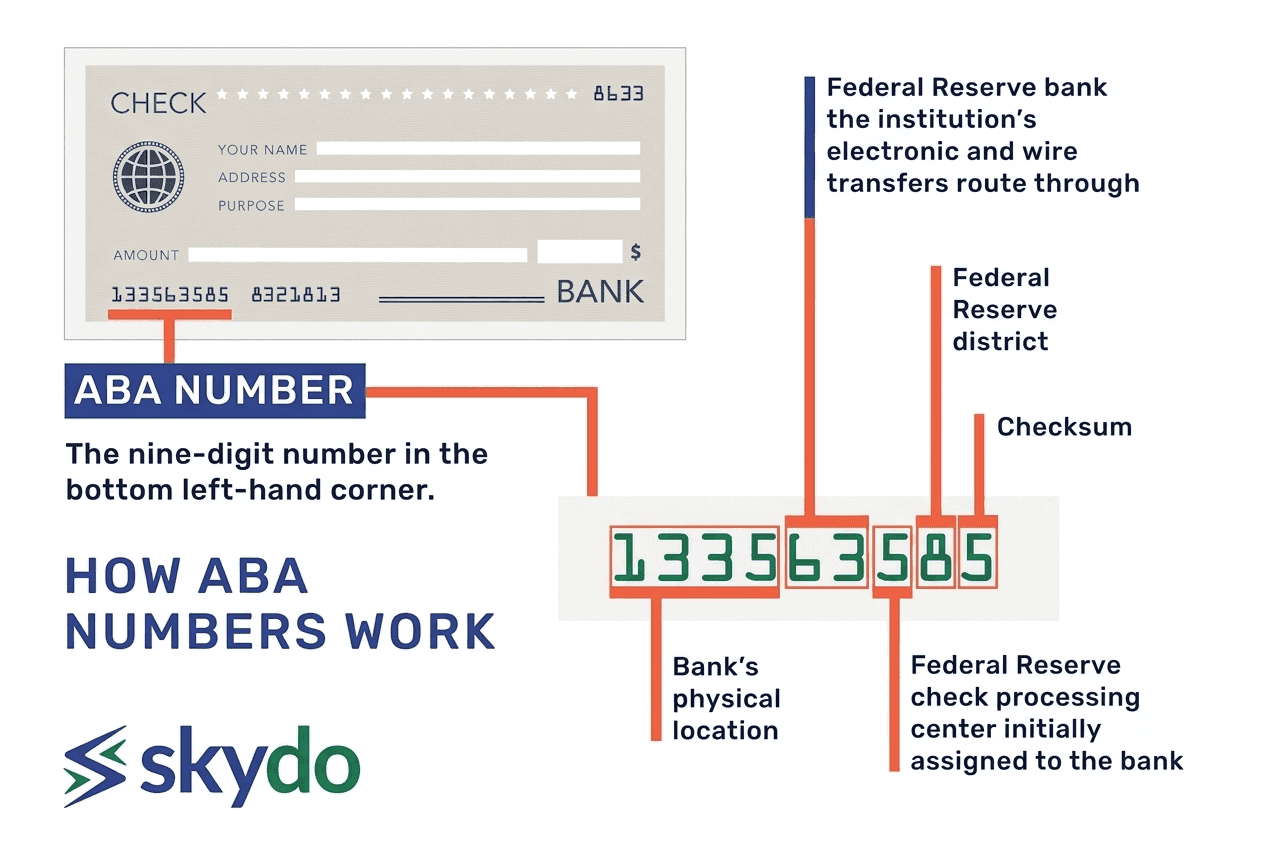
ABA number structures the nine digits as follows:
- First four digits: These digits represent the bank's physical location, specifically the Federal Reserve district and the processing area.
- Fifth and sixth digits: These show which Federal Reserve Bank handles the institution's electronic and wire transfers.
- Seventh digit: Identifies the Federal Reserve Bank check processing center originally assigned to the bank.
- Eighth digit: Shows the specific Federal Reserve district where the bank is located.
- Ninth digit: This is the check digit. It is a mathematical checksum used to verify that the previous eight digits are valid.
Let’s break down a real-life ABA number so you’re sure you understand how the structure works. The ABA routing number for Wells Fargo Bank in Minneapolis is 102307164.
1023: This is the Federal Reserve district
07: Denotes the Federal Reserve bank that handles the wire transfers
1: This digit is for the Federal Reserve bank check processing center
6: Shows the Federal Reserve district where the bank is located
4: Check digit
If you’re a math nerd, you can verify an ABA number using a mathematical formula.
Assume the first digit is f1 and the last digit as f9. Use the formula as: 3(f1 + f4 + f7) + 7(f2 + f5 + f8) + 1(f3 + f6 + f9). The resulting sum must be a multiple of 10. If it’s not a multiple of 10, it’s not an ABA number.
On a physical check, the ABA number appears at the bottom-left as the first nine digits. It is followed by the account number and then the check number. Large banks like Wells Fargo and Chase use different routing numbers depending on the state where the account was opened.
Where Can You Find an ABA Number?
You can find an ABA number in four primary locations: a paper check, online or mobile banking portal, bank statement, or the official Federal Reserve directory.
Paper check: Look at the bottom-left corner. The first sequence of nine digits is the ABA routing number. The second sequence is your account number, followed by the check number.
Online or mobile banking: After you log in to your account, open the account details or summary page. The routing number appears alongside your account number. Some banks list it as the "Routing Transit Number" or "RTN."
Bank statements: You will find the routing number under the general account information header at the top of the page.
Federal Reserve Fedwire Directory: If you’re not sure you have the right information from any of the previous methods, check the Federal Reserve Directory. It’s the best place to confirm a valid routing number for any US bank.
Always ask your clients to confirm the specific routing number for your payment type. Some banks use one number for ACH payments and a different one for wire transfers. Using an ACH routing number for a wire transfer leads to payment rejection.
Some banks have more than one ABA number. Large banks like Wells Fargo and Chase use different routing numbers for different states and payment types, so always use the exact one your account details specify, not one you found online.

ABA Number, ACH Routing Number, SWIFT, IFSC Code: Differences and Similarities
ABA numbers, ACH routing numbers, SWIFT codes, and IFSC codes are all bank identifiers used to route money. It's easy to get confused between them. Remember this thumb rule: the codes differ based on geography, the network used, and whether the transfer is domestic or international.
Let’s look at each of them.
ABA and ACH number: Many banks use the same 9-digit number for both ABA and ACH functions, but this is not always the case. A bank may use the ABA number as the "check routing number" and the ACH number as the "electronic" or "direct deposit" number.
IFSC: IFSC is the Indian equivalent of the US ABA system. It only applies to Indian banks to identify specific bank branches for local transfers. As the Federal Reserve oversees the ABA numbers in the US; the RBI oversees the IFSC code in India.
SWIFT code: This is useful for making bank-to-bank international transfers. Banks use SWIFT codes to identify international banks covered by the SWIFT network.
Please note that none of these codes are your account numbers. They identify only the financial institution or the branch; your account number identifies your specific bank account only.
If you’re receiving an international payment in your bank account, you will need a SWIFT code. Sharing the ABA number will cause a failed transaction.
| Identifier | Format | Geography | Used for | When an Indian exporter encounters it |
|---|---|---|---|---|
| ABA Routing Number | 9 digits | USA only | Paper checks, domestic wires, local operations | When using a US virtual collection account |
| ACH Routing Number | 9 digits | USA only | Domestic electronic transfers, like direct deposits and bill payments | When a US client pays via ACH to a virtual US account |
| SWIFT Code (BIC) | 8 to 11 alphanumeric characters | Worldwide | Cross-border international wire transfers | When sharing Indian bank details to receive an international wire |
| IFSC Code | 11 alphanumeric characters | India only | Domestic Indian transfers, NEFT, RTGS, IMPS | When receiving a domestic payment in India |
How Does Skydo Help in Receiving International Payments?
Skydo makes it easier for you to get paid much quickly. Using SWIFT code to receive international payments is the default choice because it’s reliable. But SWIFT transfers have hidden fees, which is the most frustrating part for 48% of businesses receiving international payments in India.
Skydo gives you free virtual US accounts that include an ABA-compatible routing number and an account number. Your US clients pay via ACH or domestic wire transfer, as if they’re paying another local vendor. They bypass the hidden SWIFT fees, and you get to keep more money.
You can create virtual accounts in multiple currencies, including USD, EUR, GBP, SGD, AUD, and CAD. There are no setup fees, and it only takes 10–15 minutes. This way, you can have a dedicated virtual account for each client to manage your cash flow effectively.
Skydo uses a flat-fee pricing model with no hidden conversion spreads:
- Under $2,000: $19 flat fee
- $2,000–$10,000: $29 flat fee
- Over $10,000: 0.3% fee
You don’t pay monthly fees; you only pay when you transact. You get a free Foreign Inward Remittance Advice (FIRA) certificate, so you don’t have to do the frustrating manual paperwork for tax compliance. Payments settle within one working day, and you get real-time alerts as the money moves from your client’s bank account to yours.
Skydo also assists with eBRC closure by linking your DGFT account and auto-mapping IRMs. We also have India-based support via WhatsApp and phone, so that we are always within your reach.
Is an ABA number the same as a SWIFT code?
ABA number is not the same as SWIFT code. An ABA number is a 9-digit code used only within the US banking system to route domestic transfers. A SWIFT code is an 8–11 character alphanumeric code used globally to identify banks for international wire transfers.
What is an IBAN, and do Indian banks have one?
Are an ABA number and IFSC code the same thing?
Do I need to share an ABA number to receive USD from a US client?
What is the full form of the ABA number?
Can a US bank have more than one ABA number?
What happens if the wrong ABA number is used?
Where is the ABA number on a check?