How to Claim Export Incentives in India: A Full Guide

TL;DR - Summary
- What are export incentives? - Government programs that refund embedded taxes and duties paid during production, making Indian exports more competitive in global markets.
- What are the main schemes? - RoDTEP refunds hidden taxes via electronic scrips. Duty Drawback refunds customs duties on imported inputs. EPCG allows 0% duty on capital goods imports. Advance Authorization gives upfront duty exemption on raw materials.
- Can freelancers and service exporters claim benefits? - Yes. Service exporters and freelancers can claim GST refunds on zero-rated exports, provided payments are received in foreign currency with correct purpose codes and proper documentation like FIRC and eBRC.
- How do you claim export incentives? - Register on the DGFT portal, file your shipping bill with an incentive declaration, ensure GST return compliance, and submit your claim online on the DGFT or ICEGATE portal.
- What causes delays in receiving incentive payments? - Data mismatches between shipping bills and GST returns, missing FIRC or BRC, wrong HSN codes, and not declaring incentive intent on the shipping bill at the time of export.
What are export incentives in India?
Export incentives are benefits, refunds, credits, and concessions given by the Indian government to exporters to make their goods and services more competitive in global markets.
Exporters end up paying several embedded taxes and duties during manufacturing or distribution that don't get refunded through regular GST or customs channels. Things like tax on electricity, fuel cess, and other hidden state and central levies. Export incentives compensate for these, so you keep a healthy margin while offering attractive pricing to your global buyers.
Types of export incentives
Here's a quick glance at the benefits covered across these programs:
- Duty Refunds: Refund customs duties paid on imported materials used to manufacture export products.
- Tax Credits: Provide electronic scrips to remit hidden central and state taxes.
- Capital Goods Benefits: Import machinery at 0% customs duty to improve manufacturing quality and capacity.
- Duty-Free Input Authorizations: Import raw materials for export production without paying duties.
- Interest Equalization: Provides subsidized interest rates on export credit to lower your borrowing costs.
What types of export incentive schemes can Indian exporters claim
Here’s an overview of the major export incentive schemes that Indian exporters can claim a refund on:
RoDTEP (Remission of Duties and Taxes on Exported Products)
The RoDTEP scheme remits central, state, and local taxes not refunded under any other program. That means you can claim a refund for electricity duty, fuel tax, and stamp duty on documentation.
You get transferable electronic scrips on the ICEGATE portal as a refund. If this is new to you, think of scrips as coupons that you can redeem to get a discount on future import duties. Or you can transfer it to a fellow importer if you don’t need it.
The scheme covers 8,555 tariff lines and the remission rate can range from 0.3% to 4.3% of the FOB value depending on your 8-digit HSN code.
Here are some sample rates:
| HSN Code | Product Description | RoDTEP Rate (% of FOB) |
|---|---|---|
| 03011100 | Freshwater Ornamental Fish | 0.3% |
| 03023500 | Bluefin Tunas (Atlantic and Pacific) | 1.9% |
| 07011000 | Potato Seeds | 2.4% |
Duty Drawback Scheme
With this scheme, you can claim a refund for customs duties on imported raw materials used in manufacturing an export order. Like a leather bag exporter claiming a refund for customs duties on imported leather.
The refund amount depends on the All Industry Rates (AIR), which are fixed percentages set by the government for various product categories.
AIR is calculated on the Free On Board (FOB) value, which is the price of goods at the time of loading them onto the vessel minus insurance and freight. However, if it covers less than 80% of your actual duties paid, you can apply for a Brand Rate.
Brand rate is a customized refund calculated for your business. It is calculated based on your evidence, such as duty payment receipts and consumption data. If approved, it can increase your reimbursement to 6–8%, but you must diligently maintain production and consumption records for the next five years to support your claim during audits.
Here’s an example of AIR and brand rate to make it simpler for you: An industrial machinery manufacturer exports an order with an FOB value of Rs.10 lakh. The AIR is 2%, so the exporter will receive a refund of Rs. 20,000. However, they paid Rs. 50,000 as customs duties on importing high-value steel and electronic controllers; AIR only covers 40% of the duties paid. The exporter is eligible for a brand rate, and after submitting all the verified receipts, he gets a refund of Rs. 50,000, 5% of the FOB value.
Export Promotion Capital Goods (EPCG) Scheme
The EPCG scheme is for manufacturers to import capital goods, like advanced machinery, computer systems, and software at 0% customs duty. The cost of high-tech equipment reduces, and businesses can upgrade their production quality and competitiveness simultaneously.
But there is one condition: the manufacturer must export goods worth six times the duty saved within six years.
Advance Authorization Scheme
You can take advantage of duty-free imports of raw materials, packaging, and fuel for manufacturing export products with this scheme. The Standard Input-Output Norms (SION) calculates the exact amount of raw material needed for an export order that you can claim duty-free.
Unlike the Duty Drawback scheme, which is a post-export refund of duties already paid, Advance Authorization is a pre-import exemption. Your initial product costs reduce, and you’re left with more working capital.
Interest Equalization Scheme (IES)
The IES provides subsidized interest rates on pre-shipment credit and post-shipment loans for MSME exporters.
Latest Update: Under the government’s recently launched Export Promotion Mission (EPM), eligible MSMEs can now receive a 2.75% interest subvention on their export credit costs.
The goal is to reduce their interest burden, allowing them to reinvest those savings into operations or improving production efficiency.
| Scheme | What It Covers | Who It's For | Key Benefit |
|---|---|---|---|
| RoDTEP | Hidden taxes like fuel, electricity, and tolls | All goods exporters | Refund via electronic scrips |
| Duty Drawback | Customs duty on imported inputs | Exporters using imported materials | Direct cash credit to bank |
| EPCG | Import duty on machinery and capital goods | Manufacturers and service providers | 0% duty on new technology |
| Advance Authorization | Pre-import raw material duties | Manufacturers with high input requirements | Upfront duty exemption |
| Interest Equalization | Interest on export loans and credit | MSME manufacturers and specific sectors | 2.75% interest subvention |
💡 QUICK INSIGHT
RoDTEP and Duty Drawback can be claimed together, but Advance Authorization and Duty Drawback are mutually exclusive for the same inputs. Pick the one that best fits your cash flow needs.
Who is eligible for tax incentives for exporters in India
Whether you’re eligible to claim tax incentives depends on what you export. Here’s what you must know:
Eligibility for goods exporters
- You must have a valid Import Export Code (IEC). Get this ten-digit code from the Director General of Foreign Trade (DGFT) if you don’t have it.
- You must have GST registration to qualify for zero-rated supply benefits and claim refunds
- File shipping bills declaring your intent to claim specific incentives at the time of export
- Verify that your HSN codes are not part of excluded sectors
- Register with the relevant Export Promotion Council to get the Registration Cum Membership Certificate (RCMC)
Eligibility for service exporters and freelancers
- Your professional fees or service payments must be in convertible foreign currency to claim GST refunds
- Use accurate purpose codes for inward remittance
- Maintain proper trail of compliance documents like, invoice, Electronic Bank Realisation Certificate (eBRC), and Foreign Inward Remittance Certificate (FIRC).
- The Service Exports from India Scheme has been discontinued. You can only claim GST refunds
💡 QUICK INSIGHT
Under Indian tax law, freelancers receiving international payments count as service exporters. If compliant, they can claim GST refunds on their exports.
How to claim export incentives: A step by step guide
How to Claim Export Incentives
Register on the DGFT portal
File shipping bills with incentive declaration
Ensure GST return compliance
Submit your claim application online
Track claim status and receive credit
Hover or tap any step to see details
Note: This is the generalised workflow. Specific steps and application requirements vary by scheme, see our dedicated guides on Duty Drawback, RoDTEP, and EPCG for more details.
Step 1. Register on the DGFT portal
Start by obtaining a ten-digit Import Export Code (IEC) from the DGFT portal. It is your unique business identifier for all international trade transactions. Link IEC to your GST registration on the portal to synchronize your trade data with tax records.
Step 2. File shipping bills with incentive declaration
A shipping bill is a mandatory customs document. File it electronically when your goods physically leave India. You must also declare your intent to claim benefits on the shipping bill, at the time of filing it.
Step 3. Ensure GST return compliance
File GSTR-1 and GSTR-3B returns regularly to be eligible for a refund claim. The government systems match the GST portal and ICEGATE data to reconcile your export invoices with shipping bill data.
Step 4. Submit claim application online
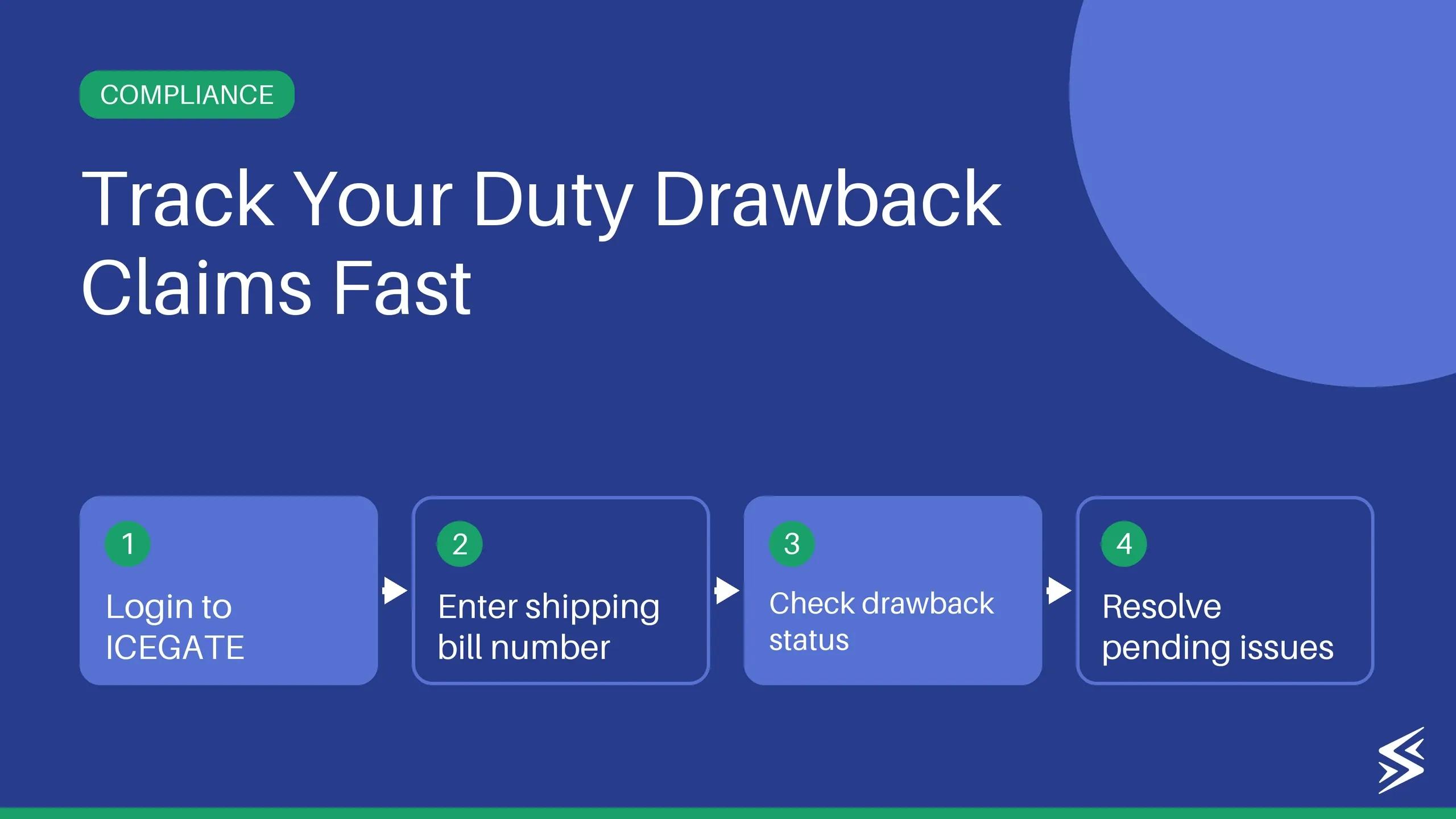
Post-shipment, log into the DGFT or ICEGATE portal to submit your application online. Provide digital copies of the shipping bill, commercial invoice, and packing list.
Step 5. Track claim status and receive credit
You can track your application’s real-time status online. Once your application is approved, you get benefits as electronic credits to your duty credit ledger.
✅ PRO TIP
Always save your shipping bill number and LEO (Let Export Order) date. You will need both to file your incentive claim.
What documents are required to claim export benefits
Most exporters have digital and physical records of essential export documents. They are required for claiming refunds and present as proof during audits.
- IEC (Import Export Code): A ten-digit alphanumeric code issued by the DGFT.
- GST registration certificate: It is a proof of tax registration used to synchronize your trade data with government tax records
- Shipping bill / Bill of Export: Mandatory customs document filed electronically at the port
- Commercial invoice: A detailed record of the exported goods that includes product descriptions and the total FOB value.
- FIRC or BRC (Bank Realization Certificate): Official banking documents proving that you have received international payment for exports.
- Packing list: A document mentioning specific contents and quantity of each package
- HS code classification documents: An 8-digit code for tariff classification and calculation of eligible incentive rates.
⚠️ COMMON MISCONCEPTION
Many exporters assume they can claim incentives without an FIRC. In reality, proof of foreign exchange realisation is mandatory for most claims.
How long does it take to receive export incentive payments
How Long Until You Get Paid
RoDTEP
15–30
days
Electronic scrips arrive after the customs scroll is generated, typically 7 to 10 days after EGM filing.
Duty Drawback
1–3
months
Most AIR credits land within 7 to 10 days of export. Complex or brand-rate cases take longer.
GST Refunds
Up to 60
days
Most exporters receive a 90% provisional refund within 7 days of filing.
Most common cause of delay: data mismatches between your shipping bills and GST returns. Even a single-character difference can stop the automated system from releasing funds.
Having realistic expectations for your payout is crucial because timelines vary based on the scheme and the verification process.
- RoDTEP: 15–30 days. You receive the electronic scrips after the customs scroll is available, which takes 7–10 days after the Export General Manifest (EGM) is filed by the vessel.
- Duty Drawback: 1–3 months. Most All Industry Rate (AIR) credits can hit your account within 7–10 days of physical export. Complex cases can stretch this timeline.
- GST Refunds: Up to 60 days. Most exporters are eligible to receive a 90% provisional refund within just 7 days of filing
Delays are most commonly caused by data mismatches between your shipping bills and GST returns. A single character difference can stop the automated system from releasing your funds.
What are common mistakes that delay export incentive claims
A minor error can cause weeks of delay, which will impact liquidity. You don’t want that and the best way to avoid it, is by preventing from making these common errors:
- Not declaring incentive intent on shipping bill: You must declare this with the “RODTEPY” code at the time of filing the shipping bill. You cannot do this later.
- Mismatched IEC and GST records: Government systems cross-verify registration data. A single-character difference will cause an immediate rejection.
- Incomplete FIRC/BRC documentation: Missing an FIRC or BRC can stall your claims or trigger government recovery notices.
- Wrong HS code classification: Incorrect 8-digit HSN codes can lead to denied claims, lower incentive rates, or even penalties
- Unfiled or inconsistent GST returns: Your claims will not be processed if GSTR-1 or GSTR-3B filings are pending
⚠️ WATCH OUT
Declare your incentive scheme on the shipping bill at the time of export. There is no retroactive option. If you miss it, you cannot claim the incentive later.
How can service exporters and freelancers claim export benefits
The claim process for service exporters and freelancers differs from that for goods exporters. Here’s how:
- You don’t need shipping bills. The entire incentive claims and declarations can be managed through the GST portal.
- You get a GST refund on zero-rated exports, which means you can recover taxes paid on your business inputs and expenses.
- Maintain accurate records of service invoices and FIRC/BRC. Also use the correct RBI purpose code on your invoice.
- Keep proper payment documentation. As the government treats undocumented exports as domestic sales, which can lead to the loss of all tax benefits.
Simplify your export payment documentation with Skydo
If you have read till here, you must have realized the importance of documentation in claiming export benefits. And it doesn’t just end there. There’s also post-payment documentation, which involves getting FIRC from the bank.
There are two challenges with banks: the process is slow, requiring multiple follow-ups, and they don’t provide an FIRC for free. Plus, banks charge costly SWIFT fees and apply forex markups on the conversion rate, which takes a deep cut in your earning.
Skydo is a modern payment platform that serves as a potent alternative to these challenges.
- You get a free FIRC instantly after receiving an international payment
- Skydo also offers eBRC closure on your behalf with bulk upload of shipping bills.
- Skydo charges a flat fee and converts foreign currency using the live mid-market exchange rate with no markup. In short, you always know how much money you will receive in your bank account
FIRC and eBRC comes in handy while claiming export benefits under various government schemes. Try Skydo.
Can I claim export incentives if I receive payments through digital platforms?
You can, but only if the platform provides a valid FIRC or BRC. That document is proof that you received payment in foreign exchange, and without it, your claim won't go through.
What happens if my export incentive claim is rejected?
Are export incentives taxable income in India?
Can startups claim export incentives?