
W-8BEN and W-8BEN-E: What is it, Who Needs It & How to Fill?

W-8BEN sorted? Now make sure US payments land cleanly with Skydo. FIRA lands in your dashboard.
TL;DR
- What is W-8BEN Form? An IRS form that certifies you are not a US person and lets you claim 0% withholding on most service income. If you receive payments as a registered business entity, you file W-8BEN-E instead.
- Who files W-8BEN Form? Freelancers, consultants, and contractors receiving US payments in their personal name. Registered companies, LLPs, and partnerships file W-8BEN-E.
- Where to submit W-8BEN Form? Directly to your US client or platform, never to the IRS.
- How long is W-8BEN Form valid? Three calendar years after it was signed. The same applies to W-8BEN-E.
- What if 30% was already withheld? File Form 1040-NR with the IRS to claim a refund. Attach your 1042-S and apply for an ITIN using Form W-7 if you do not have one.
What Is Form W-8BEN?
The W-8BEN is an IRS form that certifies you are not a US person and establishes your eligibility for tax treaty benefits. Without it, US law requires your payer to withhold 30% of every payment and remit it to the IRS. You can recover it by filing Form 1040-NR, but the process could take months.
By submitting the form, you claim benefits under the India-US Double Taxation Avoidance Agreement (DTAA), which reduces the 30% withholding to 0% for most service income such as IT, design, consulting, and similar work.
Not all US income qualifies for 0% withholding. For example, dividends from a subsidiary to a parent are taxable at a maximum of 15%, and other dividends may be taxable at up to 25%. For the full list, see the India-US treaty withholding rate table on the IRS website.

W-8BEN & W-8BEN-E Filing Guide
- ✓ Filing W-8BEN wrong?
- ✓ Line-by-line walkthrough
- ✓ IRS-proof, first try
What Is Form W-8BEN-E?
Payment Lifecycle: How Your Money Reaches You
Step 1
Step 2
Step 3
Step 4
You provide services
Client requests the form
You fill and submit
Payment is released
You serve a US client and raise an invoice
Client asks for W-8BEN or W-8BEN-E before releasing payment
You complete the form and send it back to your client
Client pays with reduced withholding under the tax treaty
Step 1
You provide services
You serve a US client and raise an invoice
Step 2
Client requests the form
Client asks for W-8BEN or W-8BEN-E before releasing payment
Step 3
You fill and submit
You complete the form and send it back to your client
Step 4
Payment is released
Client pays with reduced withholding under the tax treaty
The W-8BEN-E is the entity equivalent of W-8BEN. If you receive US payments under a registered business entity rather than your personal name, this is the form you submit instead. Like W-8BEN, it certifies that your entity is not a US taxpayer and claims benefits under the India-US DTAA, reducing the 30% withholding to 0% for most cases.
Who needs to file a W-8BEN?
The W-8BEN is for non-US individuals who earn income from a US source. If you are an Indian freelancer or consultant receiving payment from a US client, platform, or employer in your personal name, you need to fill this form.
It covers income types like fees for services, interest, dividends, royalties, and rents. In practice, for most Indian freelancers, the trigger is straightforward: if a US client or platform is paying you and asks you to fill out a tax form, this is the one.
The form does two things. It confirms to the US payer that you are not a US resident for tax purposes, and it lets you claim any benefits available under the tax treaty between India and the US, which can reduce the withholding tax applied to your payments.
W-8BEN vs. W-8BEN-E Form: Key Differences for Indian Freelancers and Businesses
Both forms do the same job, certifying your foreign status and claiming treaty benefits, but they are designed for different types of payees.
W-8BEN is for individuals. It is one page and covers freelancers, consultants, contractors, and anyone receiving US income in their own name. W-8BEN-E is for registered business entities such as Private Limited companies, LLPs, and partnerships. This is a longer form and is eight pages long.
Here is a simple comparison table:
| W-8BEN | W-8BEN-E | |
|---|---|---|
| Who files? | Individuals | Registered business entities |
| Example | Freelancer, consultant, contractor | Pvt. Ltd. company, LLP, partnership firm |
| Purpose | Certify foreign status for an individual | Certify foreign status for an entity |
| Length | 1 page | 8 pages |
| Information needed | Personal details, PAN, treaty claim | Business details, FATCA status, PAN, treaty claim |
| Tax ID to provide | Your personal PAN | Company PAN |
| Treaty article | Article 15, independent personal services | Article 7, business profits |
| Signed by | You, the individual | Authorised signatory -- Director, Partner, or CFO |
| Valid for | 3 years, or until your details change | 3 years, or until your details change |
W-8BEN and W-8BEN-E are not the only W-8 forms. Form 8233 covers individuals physically working in the US on a visa, and W-8ECI applies to foreign persons with income tied to a US branch or office.
Why Is a W-8BEN Form Required?
The W-8BEN form serves three purposes: it certifies your foreign status to the IRS, it establishes your eligibility for treaty benefits, and it gives your client the basis to release your payment without deductions.
Reduces your tax deduction: Under the India-US DTAA, the 30% withholding reduces to 0% for most service income. Without the form, your client has no choice but to deduct at the full rate.
Prevents double taxation: Your income is already taxable in India. The W-8 form ensures the US does not also tax it.
Unblocks your payment: Most US clients and platforms will not release payment until a valid form is on file. Submitting it upfront prevents delays.
How to Fill W-8BEN Form in India: A Step-by-Step Guide
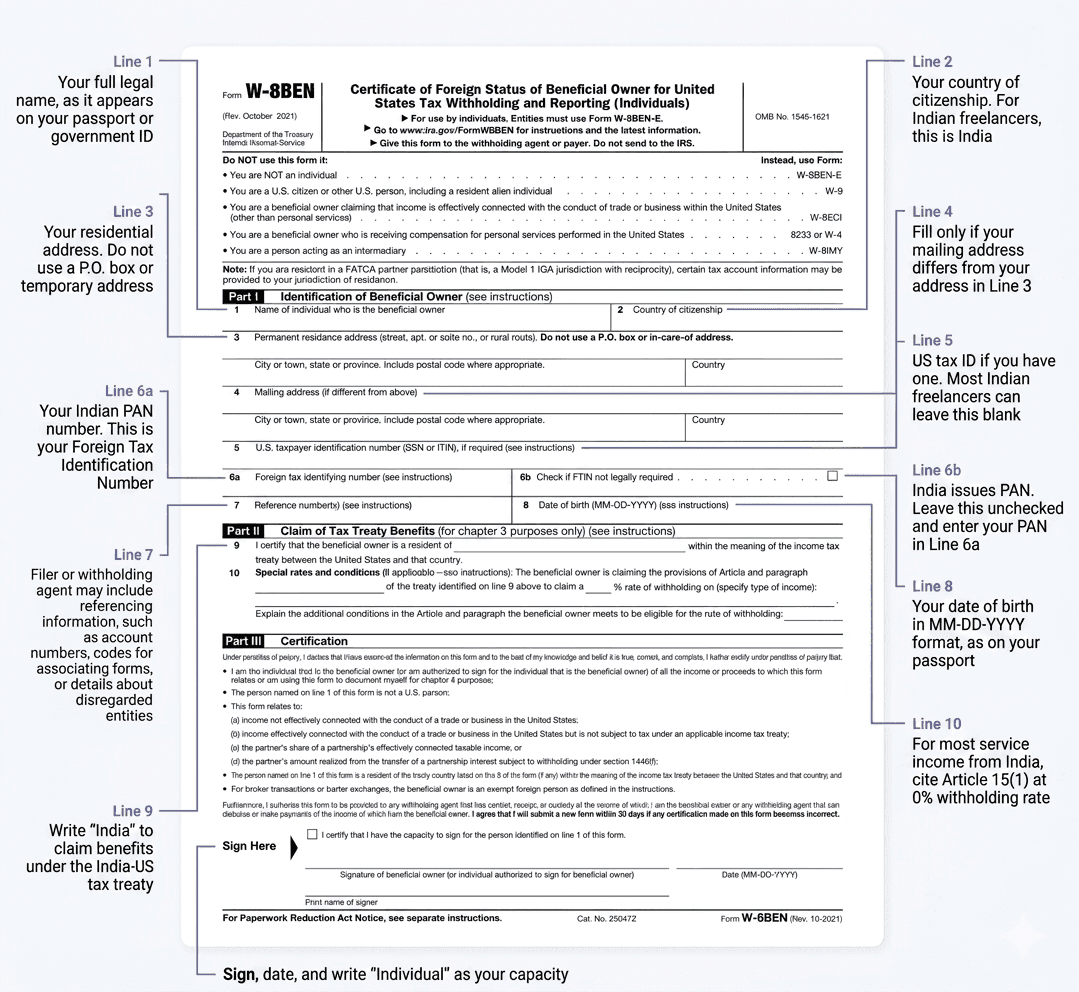
Step 1: Enter your personal details (Part I, Lines 1 to 5)
Line 1 and 2: Enter your full legal name and write India as your country of citizenship.
Line 3: Your permanent residential address in India.
Line 4: Fill this only if your mailing address is different from Line 3.
Line 5: Your US taxpayer identification number (SSN or ITIN). Leave blank if you do not have one. Most Indian freelancers will not have either.
Step 2: Enter your tax identification number (Part I, Line 6)
Line 6a: Your Indian PAN number. This is your Foreign Tax Identification Number and is mandatory if you are claiming treaty benefits.
Line 6b: Leave this unchecked. India issues PAN numbers, so the FTIN is legally required for Indian residents.
Line 8: Enter your DOB in DD/MM/YYYY format. This must match your official documents.
Step 3: Claim treaty benefits (Part II, Lines 9 and 10)
Line 9: Write India. This confirms you are a tax resident of India and are claiming benefits under the India-US DTAA.
Line 10: Cite Article 15(1) of the India-US DTAA. Write: "Claiming benefits under Article 15(1) of the India-US tax treaty. Rate of withholding: 0%. Income from independent personal services." This applies if you are providing IT, design, consulting, or similar services and do not have a fixed base or office in the US.
Step 4: Sign and certify (Part III)
Read the certification statement. Sign, print your name, add the date in MM-DD-YYYY format, and write Individual as your capacity.
Example: Article 15 in action
To illustrate the benefit: Priya is a freelance graphic designer in Mumbai earning $50,000 (about ₹40 lakh) from U.S. clients annually. Without a treaty, $15,000 would be withheld as tax (30%). By submitting W-8BEN citing Article 15, Priya’s U.S. clients withhold 0%. She thus saves ₹12 lakh in taxes each year, only paying applicable taxes in India. This shows how crucial the form is for your bottom line!
How to Fill W-8BEN-E Form: A Step-by-Step Guide for Indian Businesses
Step 1: Enter your entity details (Part I, Lines 1 to 9)
Line 1: Full legal name of your company exactly as it appears on your registration documents.
Line 2: Country where your company is registered. For Indian companies, this is India.
Line 3: Fill only if the payment is received by a subsidiary or disregarded entity. Most companies leave this blank.
Line 4: Your entity classification for US tax purposes. For most Indian companies, select Corporation.
Line 5: Your FATCA classification. Most Indian service companies should select Active NFFE (Non-Financial Foreign Entity).
Line 6: Your company's registered business address. P.O. boxes are not accepted.
Line 7: Fill only if your mailing address differs from Line 6.
Line 8: Your US taxpayer identification number. Leave blank unless your company has a US EIN.
Line 9a: GIIN (Global Intermediary Identification Number). Applies to financial institutions only. Leave blank.
Line 9b: Your company's Indian PAN number. This is your Foreign Tax Identification Number.
Line 9c: Leave unchecked. India issues PAN numbers, so the FTIN is legally required for Indian companies.
Step II: Disregarded Entity or Branch Receiving Payment
This part is usually skipped by Indian businesses that are simply paid directly. It’s only relevant if the payment is going to a branch that isn’t the main entity. Most can ignore Part II entirely
Step III: India-US Tax Treaty Claims
This is crucial for reducing withholding under the treaty as per the India-US tax convention, akin to Part II on the individual form.
First, in the line just above 14, it asks “Is the entity a resident for tax purposes in any country?” – You will enter “Yes – India” typically in the line that asks for country of residence (exact form layouts vary). Some versions have a checkbox and a blank to write the country. Ensure you indicate India clearly as your country of tax residence.
Line 14: Eligible for treaty benefits? – There’s usually a checkbox to certify that yes, the entity is a resident of the country (India) and eligible for the benefits of the treaty. Check that. You might have to write “India” in a space provided as well.
Line 15: This is where you identify the tax treaty and article. You will state something like: “India – U.S. Income Tax Treaty, Article 7, Business Profits – 0% withholding rate.”.Let’s break that down: Article 7 (Business Profits) of the India-U.S. treaty is the relevant one for most companies providing services. It says that business profits of an Indian enterprise are only taxable in India unless the enterprise has a permanent establishment (PE) in the U.S. If you have no PE (no office or branch in the U.S.), the U.S. shouldn’t tax your business profits. So you claim exemption from withholding under Article 7.You can write on line 15 something like: “The entity is claiming the benefits of the India-U.S. tax treaty, Article 7(1), to claim a 0% rate of withholding on business profits. The entity has no permanent establishment in the U.S.” This makes it clear.
Line 16: Some forms have a line 16 for “Specific conditions” – you could use that to add info like “Our company is an Active NFFE service provider, and per Article 7 income is taxable only in India.” But it’s optional if you’ve explained in line 15.
Parts IV – XXVIII
These are various certifications for different entity types (financial institutions, governments, nonprofits, etc.). The good news is that if you are a standard business entity (exporting services, software, etc.), you often can skip a lot of these parts. The W-8BEN-E form is designed to cover everything from banks to tax-exempt orgs. For a typical private limited/LLP providing services:
- Parts IV – XXIV (various FATCA classifications) are mostly “Not applicable” because you chose Active NFFE.
- Part XXV: Active NFFE – Some versions require you to fill this part to certify you meet the criteria (like <50% income is passive etc.). It may just be a matter of ticking a box or signing that part. Make sure to complete Part XXV if required (since we indicated Active NFFE in line
- Parts XXVI-XXVIII (Passive NFFE, etc.) – not needed if you’re Active.
Part XXX – Certification
(Note: On the form, the certification is usually the last section, sometimes labelled Part XXX or simply the signature block at the end.)
- Similar to the individual form, an authorised person must sign and date. For companies, this should be someone who can sign on behalf of the company – e.g. a Director, CEO, CFO, Partner, etc.
- They will print their name and title (e.g. “Director”) and the date. By signing, they certify that the form is correct and that they have authority.
That’s it. While the W-8BEN-E looks long, most Indian businesses only fill 2-3 pages of it; the rest can be left blank or marked not applicable. Always double-check the instructions if in doubt – but the above covers the usual case for Indian entities.
Example – Article 7 in action:
ABC Web Solutions Pvt Ltd in Bangalore earns $100,000 (₹83 lakh) from U.S. clients. Without a W-8BEN-E, each client would withhold $30,000 total (30%). By claiming treaty benefits with W-8BEN-E under Article 7, 0% is withheld in the U.S. ABC only pays tax in India on that income. This saves them roughly ₹25 lakh in taxes annually that would otherwise have been stuck in the U.S.
When and Where to Submit W-8BEN & W-8BEN-E Form
You do not send either W-8BEN or W-8BEN-E to the IRS. You submit it directly to your US client or the platform paying you, this is called the withholding agent. This could be a direct client, or a platform like Upwork, PayPal, or Payoneer.
For example, on Upwork, go to Manage Finances, then Tax Information, and complete the form digitally. You do not need to upload a PDF, Upwork handles it within the platform.
Once the form is submitted, it is valid for three calendar years after the year it was signed. You must submit a new form if any of your details change, such as your address or business structure.
What are the Common Mistakes to Avoid while filling W-8Ben Form
Using the wrong form: Individuals must use W-8BEN and registered entities must use W-8BEN-E. Using the wrong one creates a mismatch and your form will be rejected.
Leaving PAN blank: Without a Foreign Tax Identification Number, your treaty benefit claim may be rejected. Enter your PAN on Line 6a for W-8BEN or Line 9b for W-8BEN-E.
Skipping Part II or Part III: Filling out Part I alone only certifies your foreign status. Without the treaty claim in Part II, the 30% withholding still applies. Always complete the treaty section with the correct article and rate.
Unsigned or undated form: An unsigned form is invalid and your payer cannot rely on it. Sign, date, and fill in the capacity field before submitting.
Outdated form version: Payers reject old versions. Always download the latest version from irs.gov before each submission.
Submitting to the IRS: The IRS is not the recipient. Submit the form to your client, platform, or employer directly.
What If Tax Has Already Been Withheld Before Submitting W-8BEN?
If your US payer withheld 30% before you submitted your W-8BEN, the money is not lost. You can recover it by filing Form 1040-NR (US Nonresident Alien Income Tax Return) with the IRS for the year it was withheld. To file, you need an ITIN (Individual Taxpayer Identification Number). If you do not have one, apply using Form W-7, which you can submit alongside your 1040-NR.
The process requires some paperwork. Get the 1042-S form from your payer, which is the document they use to report how much they withheld on your behalf. Then file Form 1040-NR reporting your US-source income and claiming the applicable treaty benefit. The IRS will calculate the refund and return the difference between what was withheld and what was actually owed.
The filing deadline is April 15 if your income had US tax withholding, or June 15 otherwise.
The simplest fix is to submit your W-8BEN before the first payment. Once it is on file, your payer stops withholding and you do not have to deal with the IRS recovery process at all.
How Skydo Helps After Filing W-8BEN
Filing your W-8BEN correctly means your US clients no longer withhold tax. But getting that money into India compliantly is a separate challenge: bank fees, forex markups, and compliance paperwork like e-FIRA and purpose codes all add friction.
Skydo gives Indian freelancers and exporters a virtual USD account to receive US payments at live forex rates with zero hidden charges. Your e-FIRA is generated automatically, purpose codes are handled, and your payment lands in INR without any of the back-and-forth with your bank.
For a full guide on receiving US payments compliantly into India, see our blog on how to receive money from USA to India.

Get international bank accounts in 5 mins

Save as much as ₹10 lakh annually with Zero FX Margin

Real time payment tracking and instant FIRA
Get international bank accounts in 5 mins
Save as much as ₹10 lakh annually with Zero FX Margin
Real time payment tracking and instant FIRA
Frequently asked questions
Yes, if you are earning from a US client or platform. Without it, the payer is legally required to withhold 30% of every payment.
About the author

Solution & banking
With a decade of experience at Citi Bank, Prashanth leads payments partnerships and solutions at Skydo.

Verified by
CA Akshay KumarLatest blog posts
View all posts
International Trade: Meaning, Types, and Importance

Engineering Export Promotion Council: Membership & RCMC Guide

Export Compliance: Rules, Checklist & Guide for Indian Exporters
Related blog posts
View all postsEngineering Export Promotion Council: Membership & RCMC Guide
Export Compliance: Rules, Checklist & Guide for Indian Exporters