Cross-Currency Swap: Definition, How It Works, & Benefits

You're an Indian pharma exporter receiving payments in euros, but your loans, supplier costs, and overheads are all in rupees.
A forward contract handles short-term exposure fine. But when the risk runs for years, with interest payments and principal amounts tied to a foreign currency, you need something more structured.
That's where a cross-currency swap comes in. This article covers what it is, how the three-phase mechanism works, a real example with numbers, and when it actually makes sense to use one.
TL;DR - Summary
- What it is: - A cross-currency swap (CCY swap) is an over-the-counter derivative where two parties exchange principal and interest payments in different currencies.
- How it works: - Involves initial principal exchange, periodic interest payments (fixed or floating), and re-exchange at maturity.
- Primary uses: - Hedging long-term currency risk, accessing foreign debt markets, and optimizing borrowing costs.
- Key difference from FX swaps: - CCY swaps exchange interest payments throughout the life of the contract; FX swaps do not.
What is a cross-currency swap?
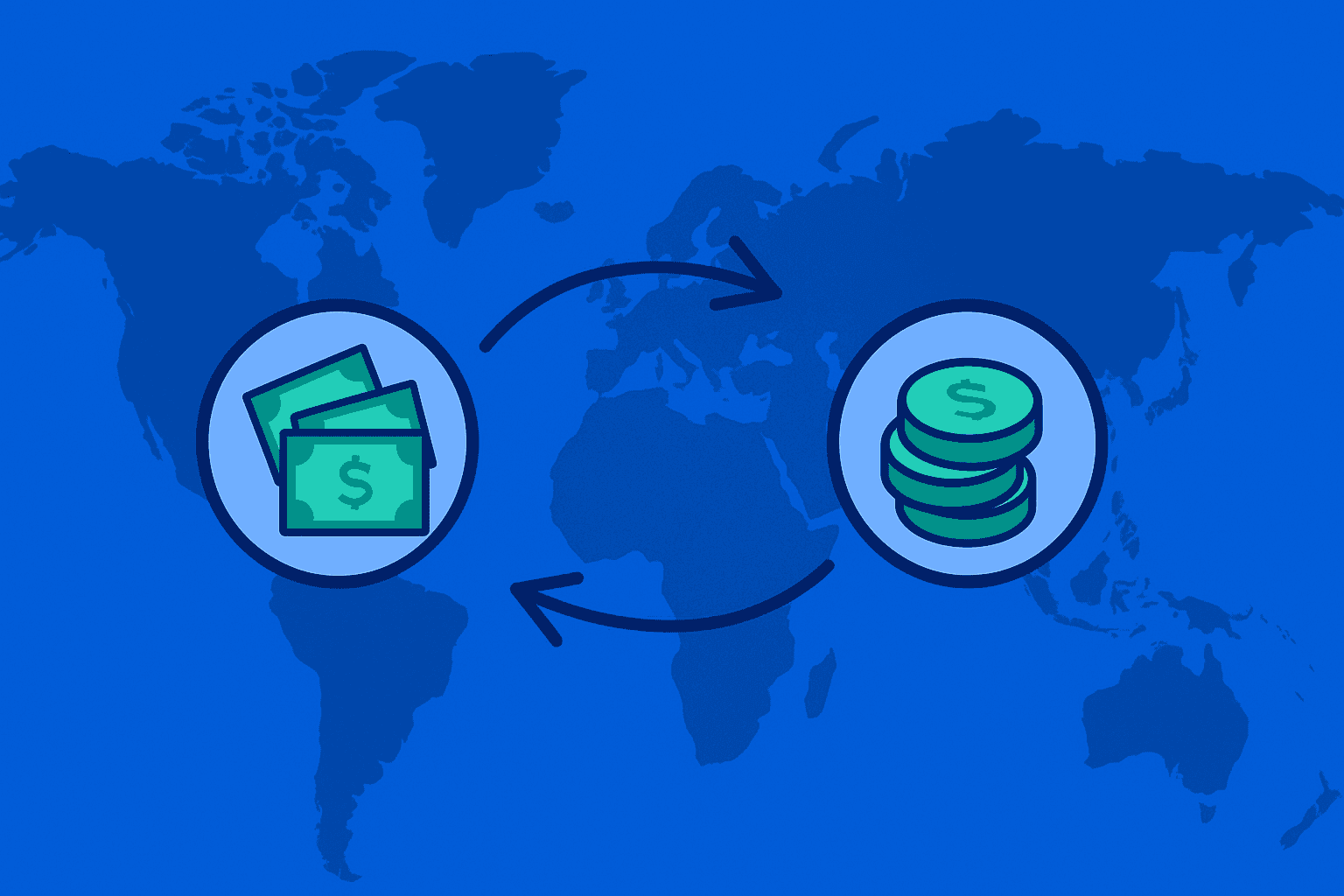
A cross-currency swap is an OTC (Over-The-Counter) derivative contract in which two parties agree to exchange principal amounts and interest payments in two different currencies over a set period.
You'll also see it written as CCY swap or XCCY swap in financial markets. In practice, these contracts are rarely arranged directly between two corporations. A bank or swap dealer typically sits in the middle, matching counterparties, facilitating cash flows, and taking on some of the credit risk in exchange for a fee. The end users, usually corporations or financial institutions, use these swaps either to hedge long-term currency exposure or to access foreign capital at better rates than they'd get locally.
A US company needs euros; a German company needs dollars. Instead of both borrowing in unfamiliar foreign markets at higher rates, they approach a swap bank. The bank structures the deal: both parties exchange principal, pay interest in the currency they received, and return the original amounts at the end.
How CCY swaps differ from other swaps
| Feature | Cross-Currency Swap | Interest Rate Swap | FX Swap |
|---|---|---|---|
| Currencies involved | Two different currencies | Single currency | Two different currencies |
| Principal exchange | Yes (initial and final) | No | Yes (different rates at start, end) |
| Interest payments | Exchanged throughout | Exchanged throughout | None |
| Typical use | Long-term currency hedging | Interest rate exposure | Short-term liquidity |
Key components of a cross-currency swap
Every CCY swap is built on five core elements that define how the agreement works from start to finish.
- Notional principal: The agreed amount exchanged in each currency at the start and end
- Exchange rate: The spot rate used for both the initial and final principal exchanges; the same rate applies to both
- Interest rate type: Fixed-for-fixed, fixed-for-floating, or floating-for-floating (basis swap)
- Tenor: Duration of the swap agreement, typically one to ten years
- Payment frequency: How often interest payments are exchanged, quarterly or semi-annually
Common Mistake
Many assume cross-currency swaps work like spot FX transactions. They're not. These are structured agreements spanning years, not instant currency conversions. The exchange rate is locked at inception, and both parties know exactly what they owe throughout the term.
How does a cross-currency swap work?
Initial exchange of principal
At spot rate, day one
Company A
US firm, needs EUR
Swap Bank
Matches & earns fee
Company B
German firm, needs USD
Periodic interest payments
Annual, for 3 years
Company A
Pays EUR interest, receives USD
Swap Bank
Routes payments
Company B
Pays USD interest, receives EUR
Final re-exchange at maturity
Same rate as day one, regardless of market
Company A
Returns EUR, gets USD back
Swap Bank
Facilitates return
Company B
Returns USD, gets EUR back
1. Initial exchange of principal
At the start of the agreement, both parties exchange principal amounts at the current spot rate. No forward rate, no negotiated markup, just the rate as it stands on that day.
Say Company A is a US firm that needs euros to fund a European acquisition. Company B is a German company that needs dollars for its US operations. Company A hands over USD 10 million; Company B hands over the equivalent in euros, say €9.2 million, at the prevailing EUR/USD spot rate. Both parties now hold the currency they came for.
2. Periodic interest payments during the swap term
Once the principal is exchanged, both parties make regular interest payments to each other for the duration of the swap.
There are three ways this can be structured:
- Floating vs. floating (basis swap): Both parties pay floating rates in their respective currencies. This is the most common interbank structure. Neither side commits to a fixed rate.
- Fixed vs. floating: One party pays a fixed rate while the other pays a floating rate. Companies use this when they want to convert variable-rate debt into something more predictable, or vice versa.
- Fixed vs. fixed: Both parties pay fixed rates throughout the term. Companies choose this when predictable payments matter more than rate flexibility.
Pro Tip
The structure you choose should mirror your existing debt profile. If your underlying loan is already floating, a fixed-for-floating swap lets you offset its variability without adding new complexity.
3. Final re-exchange at maturity
At the end of the swap term, both parties reverse the original principal exchange, at the same spot rate used on day one, not whatever the market rate is at maturity.
In an FX swap, the re-exchange occurs at a pre-agreed forward rate that reflects the interest rate differentials between the two currencies. In a cross-currency swap, the original rate remains in effect. Both parties get back exactly what they put in.

Why do businesses use cross-currency swaps?
The reasons vary by company size, debt structure, and where they operate. But they broadly fall into three buckets.
Hedging currency risk on foreign debt
Say a European company borrowed in dollars five years ago when rates looked attractive. Now it earns revenue in euros but owes quarterly dollar repayments. Every time the dollar strengthens, that debt gets more expensive in euro terms, and there's nothing the company can do about the exchange rate.
A cross-currency swap fixes the mismatch. The company swaps its dollar obligation for a euro one, so what it earns and what it owes are in the same currency. The FX risk disappears
Accessing foreign capital markets
Sometimes borrowing abroad is simply cheaper. A Japanese company might find it can raise dollar debt at 4% while domestic yen borrowing costs 6%. The catch is it earns in yen and can't carry dollar exposure long-term.
So it borrows in dollars, enters a cross-currency swap to convert the obligation into yen, and ends up paying yen interest at an all-in rate below what local lenders were quoting. It accessed a cheaper market without taking on the currency risk.
Optimizing funding costs across currencies
The cross-currency basis spread is the premium or discount built into one leg of the swap at any given time. When that spread favors your currency pair, swapping into your home currency from a foreign borrowing can cost less than borrowing outright in your home currency. Treasurers watch this number closely because the window doesn't stay open long.
Corporate treasurers monitor this spread actively.
What are the risks of cross-currency swaps?
These instruments do a specific job well, but they come with risks worth understanding before signing anything.
Counterparty credit risk
Because these contracts are negotiated directly between parties and not traded on an exchange, you're exposed if the other side defaults. You'd still owe your underlying debt but would stop receiving the swap payments meant to cover it.
ISDA agreements and collateral arrangements reduce this risk, but they don't remove it entirely, especially over a five or ten-year tenor.
Interest rate and basis risk
The basis spread built into your swap doesn't stay fixed. It moves with market conditions. If it shifts against you after you've entered the contract, your actual hedging cost ends up higher than you originally calculated.
Think of it like locking in a fuel price for your business, then watching the formula that determines your locked rate quietly move against you. The underlying risk is covered, but the cost of covering it has changed.
Settlement and liquidity risk
Cross-currency swaps are long-dated and customized. You can't exit one the way you'd sell a stock. Unwinding early means finding a willing counterparty, calculating what the position is worth at that moment, and usually paying a termination fee.
For a company whose funding needs shift mid-way through a five-year swap, that exit cost can be significant.
Cross-currency swaps require sophisticated risk management capabilities. Pricing them correctly, monitoring basis movements, and managing collateral all demand dedicated treasury expertise. For smaller businesses without that infrastructure, forward contracts or natural hedges are a more practical starting point.
Cross-currency swap example with calculations
per year
− EUR 9M
per year
+ USD 10M
per year
− USD 10M
per year
+ EUR 9M
Company A: 3-year total
Company B: 3-year total
The setup:
- Company A is a US firm that needs €9 million to fund a European expansion
- Company B is a German firm that needs $10 million for its US operations
- Spot rate at inception: 1 EUR = 1.10 USD
- Tenor: 3 years
- Company A pays 3% fixed on EUR; Company B pays 4% fixed on USD
- Interest payments are annual
Stage 1: Initial exchange
Company A and Company B don't find each other directly. They each approach a swap bank, which structures the deal and stands in the middle.
At the spot rate of 1.10, $10 million equals €9.09 million (rounded to €9 million for simplicity). The swap bank facilitates the exchange: Company A hands over $10 million, Company B hands over €9 million. Both now hold the currency they need. The bank earns a small fee built into the swap pricing.
Stage 2: Annual interest payments
Each year for three years, both parties pay interest in the currency they received, routed through the swap bank.
Company A pays 3% on €9 million = €270,000 per year. Company B pays 4% on $10 million = $400,000 per year. The bank passes these payments to the respective counterparties.
Neither party is exposed to exchange rate movements on these payments. The amounts are fixed at the outset.
Stage 3: Final re-exchange at maturity
At the end of year three, both parties return the original principal through the swap bank at the same spot rate used on day one, 1 EUR = 1.10 USD. It doesn't matter if the market rate has shifted to 1.25 or 0.95 by then.
Company A returns €9 million and receives $10 million back. Company B does the reverse. Both recover their original principal with no residual FX exposure.
| Stage | Company A pays | Company A receives |
|---|---|---|
| Initial exchange | USD 10 million | EUR 9 million |
| Annual payments (x3) | EUR 270,000 | USD 400,000 |
| Maturity | EUR 9 million | USD 10 million |
Company A effectively borrowed euros at 3% without ever going to a European bank. Company B borrowed dollars at 4% without approaching a US lender. Both accessed foreign capital through their domestic banking relationships.
How is a cross-currency swap valued?
At inception, neither party owes the other anything. The swap starts at zero value. Over time, that changes as interest rates shift and exchange rates move.
Discounting future cash flows
Every swap has two sides: payments you make and payments you receive, spread out over several years. To figure out what the swap is worth today, you calculate what those future payments are worth in today's money.
Receiving €1 million three years from now is not the same as receiving it today. You discount it back to its present value using current interest rates. You do this for both legs of the swap, then compare the two numbers.
The role of the cross-currency basis spread
Interest rates alone don't capture the full picture. There's an additional cost or saving depending on which currencies are involved and how much demand exists for each at that moment. This is the cross-currency basis spread.
If dollars are in high demand globally, borrowing dollars through a swap costs more than the interest rate alone would suggest. That premium gets built into the pricing.
Mark-to-market as conditions change
Once the swap is live, its value doesn't stay frozen. Interest rates move, exchange rates shift, and the present value of each payment leg changes with them.
This is why most institutional swap agreements require collateral. If the swap moves significantly in one direction, the party sitting on a loss posts collateral to protect the other side.
Common Mistake
A cross-currency swap that was fair at inception doesn't stay neutral over time. As rates and FX move, one party will be sitting on an unrealized gain while the other carries an unrealized loss. That's normal, and it's exactly what the mark-to-market process tracks.
How exporters can manage currency risk without complex derivatives
Cross-currency swaps are built for corporations carrying millions in foreign debt across multiple years. A dedicated treasury team, ISDA agreements, collateral management, and the infrastructure requirements alone put them out of reach for most exporters and freelancers.
SMEs often don't need to hedge interest rate exposure across currencies. They need to receive international payments quickly, know their conversion rate upfront, and avoid fees that quietly erode their margins.
- Virtual local accounts: Receive USD, EUR, or GBP as if you hold a local account in that country, without conversion delays
- Transparent FX conversion: See the rate before you confirm, no hidden margins
- Predictable flat fees: Pay a fixed amount per transaction rather than a percentage that scales with your invoice size
If you're an exporter or freelancer receiving international payments, explore how Skydo simplifies cross-border transactions with local virtual accounts and straightforward pricing.
How do cross-currency swaps apply to SMEs and exporters?
They mostly don't. CCY swaps require large notional amounts, legal documentation, and treasury expertise that most SMEs don't have. Exporters with simpler FX needs are better served by forward contracts or virtual accounts.
What are the regulatory requirements in India for entering cross-currency swaps?
What alternatives exist for smaller businesses that cannot access swap markets?
How does cross-currency basis affect real-world transaction costs?
What is the typical minimum notional amount for entering a cross-currency swap?