GR Waiver (EDF Waiver): Meaning, Rules & How to Apply

Once your GR waiver is sorted, payments still need to land cleanly. Skydo handles compliance on every export.
Not every export earns you foreign exchange. Sometimes you're sending free samples to a potential buyer overseas, replacing a damaged shipment, or participating in an international exhibition. No payment is coming back, and that's completely valid. But the RBI (Reserve Bank of India) still needs to know that the shipment happened.
That's where the GR waiver comes in. Formally called the EDF (export declaration form) waiver, it's your bank's official permission to export without the usual requirement of bringing foreign currency back into India. Without it, your shipment remains an open entry in EDPMS (Export Data Processing and Monitoring System), and open entries lead to bank follow-ups, compliance headaches, and potential FEMA (Foreign Exchange Management Act) penalties.
One more thing worth noting before we get into the details: starting October 2026, a separate GR waiver certificate won't be required. RBI is replacing the current process with a simpler nil-value EDF declaration. So if you're exporting today, this guide covers what applies now, and what's changing soon.
TL;DR
- What it is: GR waiver = permission from your AD bank to export goods without receiving foreign exchange.
- When you need it: Free samples, defective replacements, exhibition goods, repair & return.
- Limit: ₹10 lakh or 2% of average annual export realisation (last 3 years), whichever is lower.
- Critical timing: Must get the waiver before handing goods to customs. No waiver = open EDPMS entry = trouble.
- FEMA 2026 update: From Oct 2026, the separate waiver goes away. Just file a nil-value EDF instead.
What is a GR waiver (EDF waiver)?
A GR waiver is your AD bank's official permission to export goods without bringing foreign exchange back into India. Think of it as a permission slip. When you export goods commercially, RBI expects the foreign exchange to be repatriated within a set timeframe. But when you're sending something free of charge, samples, replacements, exhibition goods, there's no payment coming in. This waiver is your bank's confirmation that this particular shipment is exempt from that requirement.
The "GR" part is legacy. It stands for Guaranteed Remittance, a paper form that Indian exporters once used to declare the value of each export.
Here's why skipping it creates problems. Every export shipment automatically creates an entry in EDPMS, RBI's system for tracking export payments. That entry expects a corresponding inward remittance. When you export free of charge without a waiver, no payment is made, the entry stays open, and your bank starts sending notices. Leave it long enough, and it becomes an RBI compliance issue under FEMA.
The waiver closes that loop before it opens.

Revenue Leak Calculator
- ✓ Fees quietly eating margin?
- ✓ Current provider vs Skydo
- ✓ Reclaim what's yours
When is a GR waiver required?
Free trade samples
Invoice must say "Not for Sale"
Replacement of defective goods
Buyer's defect claim required
Repair and return
Re-export after repair or testing
Exhibition & trade fair goods
Goods may return to India
Corporate gifts & promotional items
No commercial value
In all cases: no foreign exchange is coming back to India.
Get the waiver before customs clearance — it cannot be backdated.
Any time goods leave India, and no foreign exchange is coming back, you need a waiver. FEMA requires forex realisation for all exports by default. The GR waiver for export is the official exemption to that rule, and it applies in more situations than most small exporters realise.
Free trade samples
You've found a promising buyer abroad and want to send them product samples before they commit to an order. Completely normal. But the invoice needs to explicitly say "Free Trade Sample, Not for Sale" and "Value for Customs Purpose Only."
Replacement of defective goods
Your buyer received a damaged shipment, and you're sending a free replacement. Fair enough, but you'll need to show your AD bank the original shipping bill and the buyer's defect claim.
Repair and return (re-export)
Sometimes goods are imported into India for repair or testing, then returned to the foreign owner. No sale happens. So naturally, no forex is expected. The waiver covers the value of the goods themselves, not any repair charges you invoice separately.
Exhibition and trade fair goods
You're taking goods abroad to display at an international trade fair. No payment at the port, no sale declared at customs. The goods might get sold later (in which case, forex comes back then) or they might come back to India.
Corporate gifts and promotional items
Branded merchandise, goodwill shipments, and items with no commercial value are going to partners or clients abroad.
Exporters skip the waiver for low-value samples, thinking “it’s too small to matter.” Without a waiver or payment, the EDPMS entry stays open and triggers bank follow-ups, regardless of value.
What are the monetary limits for GR waiver
There are monetary limits for a GR waiver. RBI has set annual caps based on the type of exporter you are, and if you exceed those limits, your bank will need to refer the case directly to RBI.
Status holders
If you hold a DGFT (Directorate General of Foreign Trade) status certificate (Star Export House, Trading House, etc.), you have a defined annual limit: ₹10 lakh or 2% of your average annual exports over the last three years, whichever is lower. This is a cumulative yearly cap, not per shipment. So if you're sending multiple free samples across the year, they all count toward the same limit.
Non-status holders
No fixed entitlement here. Your AD bank decides based on the nature of the transaction, your export history, and its internal risk assessment. Most banks operate with an informal threshold of around USD 25,000. Below that, approvals are generally straightforward. Above that, expect more documentation and longer processing.
Gems and jewellery exporters
This category gets a higher ceiling, ₹1 crore or 2% of average annual exports (last three years), whichever is lower. The logic is that goods in this sector carry significantly higher per-unit value, so a standard ₹10 lakh cap would be impractical.
One thing to keep in mind across all categories: these limits reset annually, but your bank tracks cumulative usage. If you're approaching your cap mid-year, flag it early rather than risk a shipment getting stuck.
Track your cumulative free-of-cost exports through the year. If you’ve used ₹8 lakh of your ₹10 lakh limit, mention the remaining ₹2 lakh in your next application, banks appreciate transparency.
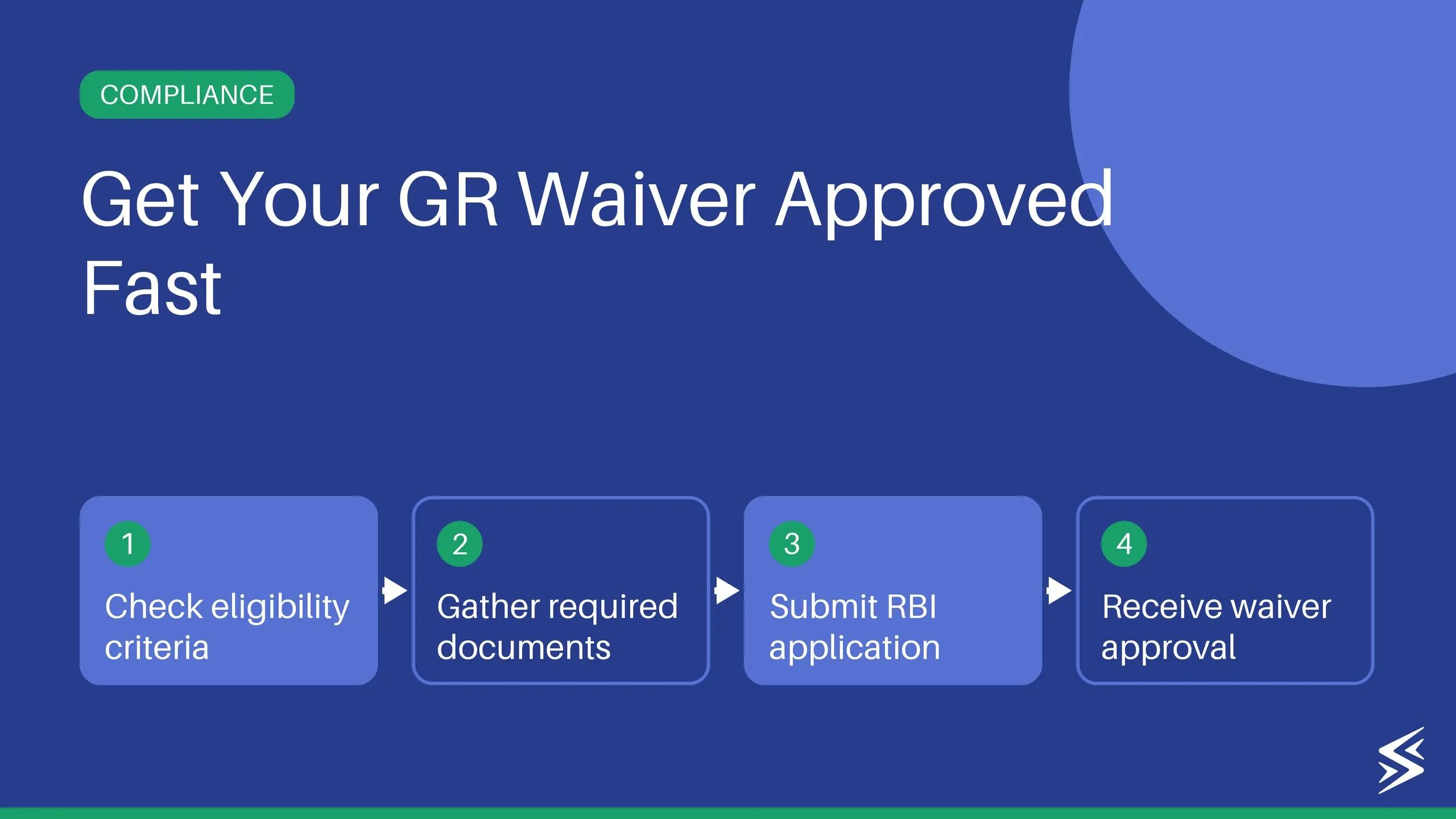
How to apply for a GR waiver
The process isn't complicated, but the sequence matters. Getting the waiver before customs clearance is non-negotiable, you can't backdate it.
- Start by checking how much of your annual limit you've already used. If you're a status holder, your bank should have a running record of your status. If you're not, ask your relationship manager what their internal threshold looks like for your transaction value.
- Once that's clear, pull your documents together (checklist below) and write a formal request letter to your AD bank explaining the purpose of the export, sample, replacement, exhibition goods, whatever applies. Be specific. Vague letters slow approvals down.
- Your bank will verify that the purpose is genuine, they're checking that this isn't a commercial export dressed up as a freebie. Once satisfied, they issue the waiver and record it against your EDPMS entry. After that, you proceed with customs clearance as usual.
Documents you'll need
Your request letter is the starting point, a clear, formal application stating the nature of the export and why no forex will be realised. Along with that:
- A proforma invoice that explicitly says "Value for Customs Purpose Only" and "Free of Cost."
- Product literature or technical specifications help establish that what you're sending is genuinely a sample or spare part, not a commercial shipment.
- If this is a replacement for a defective export, include the original shipping bill and invoice alongside the buyer's defect claim.
- For exhibition goods that will be returned to India, your bank will require a re-import undertaking. For higher-value shipments, some banks require a CA certificate.
If you're unsure which export documents go alongside your waiver application, Skydo's export documentation guide covers the full picture.
GR waiver request letter format
Subject: Request for EDF / GR Waiver for Export of ______________
Dear Sir / Madam,
— Paragraph 1: What is being exported We refer to our Proforma Invoice No. ______________ dated ______________. We intend to export __________________________ (product description) to __________________________ (buyer name, country).
— Paragraph 2: Purpose — be specific, vague language slows approval The goods are being exported as __________________________ (Free Trade Samples for evaluation / Warranty replacement for Shipping Bill No. ___ dated ___ / Exhibition goods for ___ trade fair). The invoice is marked "Free of Cost" and "Value for Customs Purpose Only."
— Paragraph 3: No forex declaration We hereby declare that no foreign exchange will be realised against this shipment. The declared value of ______________ is the bona fide market value of the goods.
— Paragraph 4: Cumulative limit — show your bank you've done the math Our cumulative free-of-cost exports during the current financial year amount to ₹ ______________ against our annual entitlement of ₹ ______________. This shipment of ₹ ______________ falls within our remaining limit of ₹ ______________.
We request you to kindly grant the EDF / GR waiver for the above shipment and oblige.
Yours faithfully,
__________________________________
(Authorised Signatory Name & Designation)
__________________________________
(Company Name & Seal)
Underlined fields are to be filled in. Ask your bank's relationship manager if they have a preferred template — using their format can speed up approval.
Many banks don't give you a template. You're expected to write the letter yourself, and a poorly worded one will prompt questions. Here's the structure that works.
- Start with the date and your bank branch's full address. Your subject line should read: "Request for EDF/GR Waiver for Export of [Product Name]."
- In the first paragraph, reference your proforma invoice number and date. Keep it factual, just state what's being exported and to whom.
- The second paragraph is where you state the purpose clearly. "The goods are being exported as Free Trade Samples to [buyer name] for evaluation purposes," or "This shipment is a warranty replacement for goods exported under Shipping Bill No. [X] dated [date]." Be specific. Generic language like "free of cost export" without context raises flags.
- In the third paragraph, explicitly declare that no foreign exchange will be realised against this shipment and that the value stated is bona fide, meaning it reflects actual cost, not an inflated number.
- The fourth paragraph should mention your cumulative free-of-cost exports so far in the current financial year and your remaining limit. This shows your bank you've done the math and you're within entitlement.
- Close with your authorised signatory, designation, and company seal.
Ask your bank’s relationship manager if they have a preferred template. Most branches do. Using their format speeds up approval.
What's changing under FEMA 2026?
If you've ever found the GR waiver process unnecessarily complicated for something as straightforward as sending a product sample, RBI agrees with you.
From October 2026, the separate EDF waiver is being discontinued. No waiver letter, no bank approval, no CA certificate for most cases. If you're exporting goods without payment, you simply file the EDF with a nil value. The form itself becomes the declaration. Your bank still verifies the transaction is genuine, but that happens as part of the standard EDF process, not as a separate approval step before it.
What does this mean for you?
- Until October 2026, the current process applies. Get your waiver from the bank before customs clearance. Nothing changes in how you handle shipments between now and then.
- After October 2026, you file a nil-value EDF and move on. Simpler paperwork, fewer touchpoints, same compliance outcome.
The one thing to do before the transition: close any open EDPMS entries from existing waiver shipments. Old entries don't automatically resolve under the new system. If you have shipments sitting open, sort them out now rather than carrying them into the new regime.
Whether you’re exporting samples or commercial shipments, Skydo gives you instant FIRA, correct purpose codes, and clean compliance docs.
GR Waiver vs EDF Waiver vs Nil-Value EDF: Quick Comparison
The terminology can get confusing, especially when your bank says one thing, your CHA says another, and RBI's circulars use a third.
Here's a quick breakdown of what each term actually refers to and where it sits in the timeline.
Common mistakes with GR waivers
Compliance issues with GR waivers often don't happen because exporters are careless. They happen because the process has a few non-obvious rules that nobody tells you upfront.
Exporting without first getting the waiver is the most common. Once your shipment is out, the EDPMS entry is already open and expecting payment. There's no clean way to fix it retroactively, you're stuck chasing a closure that should never have been needed. Get the waiver before customs clearance, every time.
Getting the customs value wrong trips up many first-time exporters. The commercial value of your shipment may be zero, but customs still need an accurate market value to assess duties. Declare the fair market value and add "Value for Customs Purpose Only" on the invoice. Both things need to be true at the same time.
Exceeding your annual limit without realising it is easier than it sounds if you're sending multiple small shipments across the year. Each one eats into your cap. Keep a running tracker; a simple spreadsheet works, so you're not caught short before an important shipment.
Claiming export incentives on waiver shipments is a mistake that can surface much later during audits. RoDTEP (Remission of Duties and Taxes on Exported Products) and Duty Drawback aren't available on free-of-cost exports. Mark these shipments clearly in your records to avoid any ambiguity.
Not following up on EDPMS closure is the one thing people most often forget. The waiver doesn't automatically close the entry; your bank has to do that. Follow up within 30 days of the shipment. Don't assume it's been handled.
Finally, if you're sending exhibition goods, track your re-import deadlines. Goods that don't return within the permitted period attract duties. It's an avoidable cost that becomes unavoidable if you lose track of the timeline.
💡 A GR waiver doesn’t make the export invisible to EDPMS. It still creates an entry, the waiver just tells the system not to expect payment. Make sure your bank closes it.
GR waiver and EDPMS, how they connect
Every export shipment creates an entry in EDPMS, RBI's system for tracking whether export payments have come back into India. Every single one, including the ones where no payment was ever expected.
For commercial exports, the entry closes when your payment arrives, and your bank matches the inward remittance to the shipment. Straightforward.
For waiver exports, there's no payment coming. So the entry closes differently, your bank marks it against the waiver approval. That's it. But this only works if the waiver was properly recorded at the time of export. If it wasn't, the entry just sits there, open, looking exactly like a missed payment. Your bank can't tell the difference from the outside.
This is why the sequence matters: waiver first, then customs, then shipment. In that order.
Under the 2026 rules, nil-value EDFs will close automatically in EDPMS. No separate follow-up needed. It's one of the more practical improvements of the new system, and one less thing to track manually.
How Skydo helps exporters stay compliant
GR waivers handle exports where no money is returned. But for your commercial exports, the ones where forex should come back, compliance gets complicated in a different way. Hidden FX margins, delayed FIRA (foreign inward remittance Advice), messy records when it's time to close EDPMS entries.
Skydo sorts that out. You get live forex rates with zero margin, so what you see when the payment is initiated is what actually lands.
FIRA comes instantly with every payout, no following up with your bank, no waiting days for a document you needed yesterday. Purpose codes are handled correctly, ensuring your AD bank receives clean data and your EDPMS entries close without friction. And when the 2026 reporting rules kick in, your transaction records will already be in order.
Your waiver exports don't earn forex, but your commercial exports should earn more.
Stop chasing your bank for firc. Get instant FIRA, live forex, and clean compliance docs with every payment.

Get international bank accounts in 5 mins

Save as much as ₹10 lakh annually with Zero FX Margin

Real time payment tracking and instant FIRA
Get international bank accounts in 5 mins
Save as much as ₹10 lakh annually with Zero FX Margin
Real time payment tracking and instant FIRA
Frequently asked questions
A GR waiver is official permission from your AD bank to export goods without bringing foreign exchange back into India. It applies when the export is free of cost, samples, replacements, exhibition goods, and no payment is expected from the buyer.
About the author

Solution & banking
With a decade of experience at Citi Bank, Prashanth leads payments partnerships and solutions at Skydo.

Verified by
CA Abhilove ShardaLatest blog posts
View all posts
International Trade: Meaning, Types, and Importance

Engineering Export Promotion Council: Membership & RCMC Guide
Export Compliance: Rules, Checklist & Guide for Indian Exporters
Related blog posts
View all postsEngineering Export Promotion Council: Membership & RCMC Guide
Export Compliance: Rules, Checklist & Guide for Indian Exporters