
Annual Performance Report Filing: Complete Guide for 2026

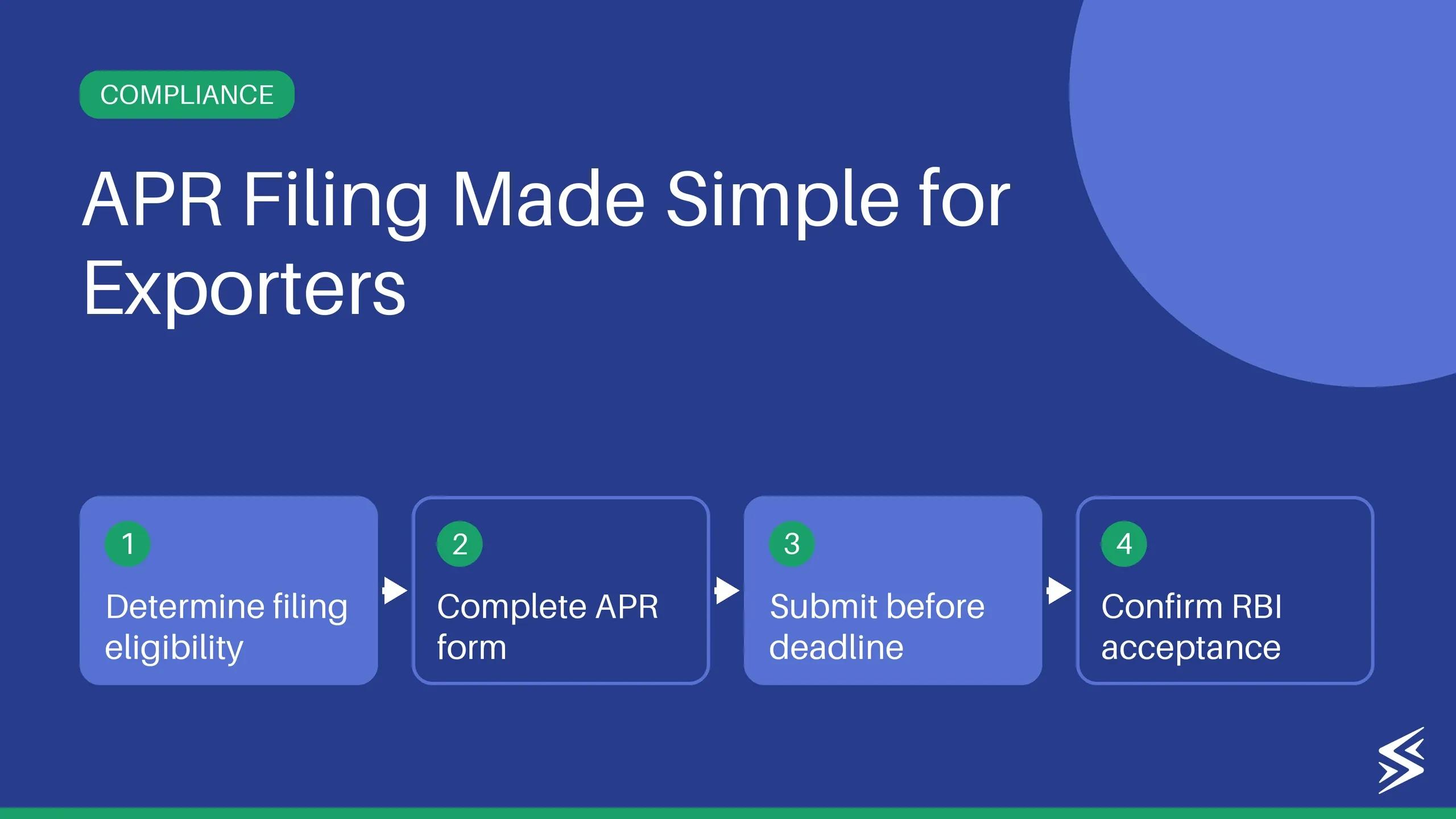
APR filing needs clean payment records. Skydo auto-generates FIRA and keeps your export receipts audit-ready.
If you run a SaaS company with a Wholly Owned Subsidiary (WOS), having audited financial statements is not the only regulatory requirement. You must also file an Annual Performance Report (APR) before December 31st every year. Failing to do that will block future outward remittances.
Filing APR is non-negotiable if you want to continue receiving international payments in India from your WOS or Joint Ventures (JV). If you’re new to APR, read this blog till the end. It covers what goes into the report, how to file it, penalties, and how to fix noncompliance.
TL;DR
- Who must file: Any Indian entity or resident individual with an overseas JV or WOS.
- How to file: Approach your AD bank and fill out Form ODI Part II.
- Deadline: December 31 every year — no extensions, no exceptions.
- Cost of missing it: FEMA violation. AD bank can block all outward remittances, and penalties can scale up to 300% of the total investment amount.
- Multiple investments: File a separate APR for each foreign entity.
What is the Annual Performance Report
The Annual Performance Report (APR) is a mandatory yearly update you submit to the RBI about your overseas Joint Venture (JV) or Wholly Owned Subsidiary (WOS).
The RBI mandates this under Foreign Exchange Management Act (FEMA) because Indian capital moving abroad falls under Indian law. Even if the business operates overseas, you’re accountable for how that foreign exchange is used.
Using APR, the RBI monitors and verifies the compliance of overseas businesses with investment guidelines.
For example, if you own a marketing subsidiary in Dubai, the RBI uses your APR to confirm the company is operational. It also checks if any form of cross-border payments, like dividends or consultancy fees, are transferred to your Indian bank account and not sitting offshore indefinitely.
The APR is mandated under the Foreign Exchange Management (Overseas Investment) Rules, 2022, which replaced the older ODI framework. If your entity made investments under the old FEMA 120 regulations, the APR obligation still applies.

Revenue Leak Calculator
- ✓ Fees quietly eating margin?
- ✓ Current provider vs Skydo
- ✓ Reclaim what's yours
Who Must File the APR Under FEMA Regulations
If your stake is classified as Overseas Direct Investment (ODI), you must file an APR. We will tell what type of investment classifies as ODI in this section.
A quick note before we get there: you must file a separate APR for every foreign entity you have invested. Even if your overseas subsidiary is dormant or has zero revenue, the obligation exists as long as the investment does.
Indian Parties with Overseas Direct Investment
If your Indian private limited company, LLP, or registered partnership firm has a JV or WOS abroad, you must file an APR every year. This also applies to public sector undertakings and certain trusts or societies.
Resident Individuals with Foreign Entity Stakes
Resident Indians who invested in a foreign business equity through the Liberalised Remittance Scheme (LRS) also fall under the APR mandate.
Filing Responsibility When Multiple Investors Hold Stakes
For multiple Indian investors holding stakes in the same foreign company, the investor with the highest percentage stake must take responsibility for filing. If stakes are equal, the investors must mutually agree on who files and document that arrangement.
Exemptions from APR Filing Requirements
- Minority Holders: You hold less than 10% equity in a listed foreign entity, have no controlling interest, and have no other financial commitments such as loans or guarantees. Such investments are treated as Overseas Portfolio Investment (OPI).
- Liquidation: Once your foreign entity officially enters liquidation, your reporting obligation ends from that date.
Completing disinvestment does not automatically end your APR obligation. If the disinvestment happened mid-year, you are still required to file an APR for that financial year covering the period during which you held the investment.
What is the deadline for APR Filing in 2026
The deadline to file your APR form is December 31 every year. For 2026, submit the annual performance report by December 31, 2026.
This date follows the Indian calendar, regardless of which financial year your foreign entity follows locally. The report filed by December 31, 2026, must cover your foreign entity's accounting period ending by March 31, 2026.
Here’s some friendly advice: start collecting your overseas subsidiary financials by October 1. This will give a 90-day preparation window to your auditors to certify documents and avoid last-minute hassle.
Documents Required Before Filing the APR
Here’s a list of essential documents you need while filing APR:
Financial Statements from the Foreign Entity
You need the latest financial statements of your overseas JV or WOS. This includes the Balance Sheet, Profit & Loss account, Notes to Accounts, equity contribution of the Indian entity, and the net worth of the foreign company.
UIN and Prior RBI Approvals
Your Unique Identification Number (UIN) is a 13-digit alphanumeric code assigned by the RBI on your first foreign investment. Make sure all previous remittances and RBI approvals are correctly mapped to this number in your bank's records.
Repatriation and Disinvestment Records
You must keep a trail of documents if you repatriate funds, like dividends, royalties, or consultancy fees. The Foreign Inward Remittance Certificate (FIRC) is the key document as it proves that the funds came back to India. If you sold any shares, disinvestment proceeds records are also required.
How to Complete Form ODI Part II
Form ODI Part II is the RBI's standardized format for tracking your investment's health through AD banks. The documents collected in the last step will help you fill out the following details:
Capital Structure and Shareholding Details
In this part, you must report the ownership status as of the last day of your foreign entity's accounting year. Include total equity capital and the percentage held by you versus foreign partners. Also record any changes in shareholding that occurred during the year.
Operational and Financial Performance Data
You must provide two-year comparative data covering:
- Gross Turnover/Revenue
- Net Profit or Loss (losses in brackets)
- Current Net Worth
If your subsidiary is in its first year of operation, single-year data is sufficient.
Repatriation of Dividends and Dues to India
This section tracks 11 specific repatriation points for international payments: dividends, loan repayments, royalties, technical know-how fees, and more.
For each, report two figures: the amount you were entitled to receive and the amount actually repatriated. The RBI uses this to ensure earned foreign exchange isn't being held outside India longer than permitted.
How to File the Annual Performance Report
Filing an annual performance report is easy if you have collected the documents early on. Once you have them, follow the process below to complete filing:
Collect Documents and Financial Statements
You need your foreign entity's latest balance sheet and profit and loss account. These must be audited unless you don't have control and the host country doesn't require one.
Fill Form ODI Part II Accurately
Use capital letters, report actual amounts without rounding, and ensure all figures are in a single foreign currency (non-equity exports in INR). Include two-year comparative performance data. Your statutory auditor must certify the form, and the authorized signatory must sign and stamp every page.
Submit Through Your Authorised Dealer Bank
Submit the completed ODI Part II to the AD bank branch that facilitated your original investment. Keep two physical sets, one for the RBI's Regional Office and one for the Ministry of Commerce. Some banks now accept submissions through digital trade portals or the FIRMS (ODI) portal.
Save Acknowledgment and Maintain Records
Once your AD bank verifies and uploads the report, they will issue a stamped acknowledgment. This is your official proof of timely filing.
When Audited Financial Statements Are Required
The audit requirements tightened significantly after August 22, 2022. The rules are now stricter to ensure the RBI receives verified data.
Mandatory Audit Scenarios
You must submit audited financials in either of these cases:
- You have control: A stake of 10% or more, or the right to appoint directors, requires audited statements
- Host country law: If local laws require an audit, you must submit audited documents regardless of your ownership percentage.
When Unaudited Financials Are Acceptable
If neither condition applies, unaudited financials are acceptable. However, they must be certified by your Indian statutory auditor or a Chartered Accountant, and your Board of Directors must formally ratify them.
Penalties for Late or Non-Filing of APR
If you miss filing APR or file it at a later date, you might face these consequences:
- Late Submission Fee (LSF): An immediate penalty of ₹7,500 per return for filing after the deadline.
- Compounding Penalties: Continued non-compliance can attract penalties of up to 300% of the total investment amount.
- Future Blockages: Your AD bank will block future outward remittances and new financial commitments until the non-filing is resolved.
Beyond the compounding penalty under FEMA, a non-filing flag on your ODI record can block your AD bank from processing future outward remittances, including routine dividend repatriations from your overseas entity back to India.
Common APR Filing Mistakes and How to Avoid Them
Here’s a list of the most common mistakes individuals, and entities commit while filing APR. Check for these mistakes to avoid any hassle:
- Incorrect financial year mapping: Getting confused between the financial years is a very common mistake. Remember: APR filing must cover the foreign entity’s accounting period that ended on or before 31st March of the same year.
- UIN mismatches: Your 13-digit UIN must match exactly across Form ODI Part II, your foreign entity's financials, and all RBI records.
- Rounding off financial figures: Always report actual amounts. Do not round to the nearest thousand or million.
- Incorrect data formatting: Report losses in brackets, use CAPITAL LETTERS throughout, and follow the DD/MM/YYYY date format.
- Wrong audit decision: You must submit audited financials if you hold 10% or more stake or have control over the foreign entity. Unaudited statements are only acceptable when you lack control and the host country doesn't mandate an audit .
- Incomplete repatriation records: The RBI tracks 11 repatriation categories including dividends, royalties, and loan repayments. Reconcile every entry against your FIRCs before filing.
- Shareholding figures not reconciled: The ownership percentage you report must match your foreign entity's official cap table as of the last day of its accounting year.
- Not saving the bank acknowledgment: This stamped document is your only legal proof of timely filing. Without it, future remittances may be flagged or blocked.
Simplify ODI Repatriation and Cross-Border Payment Compliance with Skydo
The Annual Performance Report takes care of compliance. But for managing international payments, like dividends, most Indian businesses rely on swift transfers. This means high fees, unpredictable timelines, and a manual paper trail.
Skydo offers a simpler alternative. As an RBI-authorized cross-border payment platform, it gives your foreign entity local receiving accounts in USD, GBP, and EUR, so money moves through local networks instead of SWIFT. You receive the money in one business day at live exchange rates, with no conversion charges or hidden markups.
For every transaction, Skydo auto-generates a digital FIRA. By December 31, your repatriation records will already be in order.

Get international bank accounts in 5 mins

Save as much as ₹10 lakh annually with Zero FX Margin

Real time payment tracking and instant FIRA
Get international bank accounts in 5 mins
Save as much as ₹10 lakh annually with Zero FX Margin
Real time payment tracking and instant FIRA
Frequently asked questions
Contact your AD bank and request a revised filing. Submit a corrected Form ODI Part II along with a covering letter explaining the error. Your bank will verify the changes and re-upload the corrected report to the RBI portal.
About the author

Solution & banking
With a decade of experience at Citi Bank, Prashanth leads payments partnerships and solutions at Skydo.

Verified by
CA Abhilove ShardaLatest blog posts
View all posts
International Trade: Meaning, Types, and Importance

Engineering Export Promotion Council: Membership & RCMC Guide

Export Compliance: Rules, Checklist & Guide for Indian Exporters
Related blog posts
View all postsEngineering Export Promotion Council: Membership & RCMC Guide
Export Compliance: Rules, Checklist & Guide for Indian Exporters