EDF Filing Guide: What Changes in 2026 for Exporters

Skydo auto-generates FIRA, and closes eBRC for you so that you never have compliance nightmares
TL;DR
- What is EDF? A mandatory form that declares the value of your export to RBI. It creates a tracking entry in EDPMS that stays open until your payment arrives and is verified by your bank.
- Who needs to file it? All goods exporters. From October 2026, service exporters including freelancers, agencies, and SaaS companies must also file. This is new.
- How is it filed for goods exports? At most major ports, it is auto-filed as part of your shipping bill on ICEGATE. No separate action needed.
- What is changing in 2026? SOFTEX is being phased out and replaced by a unified EDF framework. Service exporters get 30 days from the end of the invoice month to file, and can club all monthly invoices into one form.
- What happens if entries are not closed on time? Bank follow-ups, caution listing, loss of export benefits like RoDTEP and duty drawbacks, and penalties of up to three times the export value.
What is the Export Declaration Form (EDF)?
The Export Declaration Form (EDF) is a mandatory document that records the value and details of goods or services you're exporting from India. Under FEMA regulations, it serves as an official declaration to RBI that an export has occurred and that payment is expected. Every exporter in India must file it, there are no exceptions for commercial exports.
If the EDF is not filed correctly, the corresponding EDPMS (Export Data Processing and Monitoring System) entry may remain unresolved, which can delay eBRC generation and lead to export compliance issues under FEMA regulations.
Here's how EDF works:
- EDF is automatically triggered when an exporter files a shipping bill on ICEGATE.
- This tracking entry is on RBI’s EDPMS.
- That entry stays open until the exporter’s payment comes in and the bank verifies it.
- The payment details and the details from EDF are required to obtain eBRC (electronic Bank Realization Certificate) from DGFT portal.
- The eBRC is proof that an export has been made, and also helps the exporter claim benefits like RoDTEP refunds and duty drawbacks.
💡 QUICK INSIGHT
EDF is not the same as a shipping bill. The shipping bill is a customs document, while the EDF is RBI's exchange control document. At most ports, the EDF is auto-filed with the shipping bill.

Revenue Leak Calculator
- ✓ Fees quietly eating margin?
- ✓ Current provider vs Skydo
- ✓ Reclaim what's yours
Why is EDF required?
The EDF is required because the RBI must track all exports and verify that foreign exchange earnings are repatriated to India. This is mandated under FEMA (Foreign Exchange Management Act), which regulates cross-border transactions. Without the EDF, RBI has no way to monitor whether export proceeds were received or repatriated as required by law.
- EDF confirms that the shipment complies with customs rules, export controls, and foreign trade requirements.
- It provides essential export data used for trade monitoring, policy planning, and incentive schemes.
- It acts as proof of export for banks, DGFT compliance, GST filings, payment reconciliation, and incentive claims.
Who needs to file an EDF?
| Exporter Type | File Now? | After Oct 2026 | How They File |
|---|---|---|---|
| Goods Exporters Physical products shipped abroad | EDF | EDF | Auto-filed with shipping bill at major ports. Manual filing at smaller ports via bank. |
| Software / IT Exporters IT, ITeS, SaaS companies | SOFTEX | EDF | SOFTEX via STPI or SEZ until Oct 2026. Then monthly EDF: one form per month, not per invoice. |
| Freelancers & Agencies Design, marketing, legal, consulting | None | EDF | New obligation from Oct 2026. File within 30 days of month-end. |
| E-commerce / Amazon Sellers Courier & marketplace shipments | EDF | EDF | Each courier shipment auto-creates an EDPMS entry. Every entry must be matched and closed. |
Goods exporters: Yes. If you're shipping physical products out of India, you need to file an export declaration form.
Software exporters (IT/ITeS): Right now, software exporters file a different form called SOFTEX through STPI or SEZ authorities. But from October 2026, SOFTEX is being phased out, and everyone will need to file the EDF instead.
Service exporters (non-software): Freelancers, consultants, and agencies providing services such as design, marketing, legal, accounting, business consulting, or financial advisory to clients outside India are generally classified as non-software service exporters. At present, most non-software service exporters do not separately file an EDF. However, under the new FEMA 2026 regulations, service exporters will also be brought under the EDF framework from October 2026 onward.
Amazon and e-commerce sellers: Every commercial courier shipment you send abroad automatically creates an EDPMS entry. Many sellers have hundreds of open entries sitting in the system and don't even know it. Each one needs to be matched with a payment and closed.
What's changed with EDF under FEMA 2026?
New rules were notified on January 13, 2026. They go live on October 1, 2026.
Here's what's changing.
- Service exporters must now file an export value declaration form.
- You get 30 days from the end of the invoice month to file. So if you raised invoices in March, you have until April 30 to submit your EDF.
- You can club all your monthly invoices into one form, no need to file separately for each invoice.
- Software exports are now covered under the unified EDF framework alongside other service exports.
- For service exports submitted outside the EDI system, Authorised Dealers must update the EDF details in EDPMS within five working days of receiving the EDF.
- Exporters can declare nil export value in cases where goods are exported without consideration, such as certain free sample shipments.
- AD banks are required to publish their export compliance policies and grievance escalation mechanisms.
- Banks cannot levy penalties or charges on exporters for regulatory delays or compliance violations.
What does this mean for you?
- Amazon and e-commerce sellers: No major change. Your shipping bill filed through customs continues to serve as the EDF for goods exports.
- IT and software exporters: Software exports will move to the unified EDF framework from October 2026, replacing the separate SOFTEX-based reporting process.
- Freelancers, consultants, and agencies: Service exporters will now come under formal EDF reporting requirements. You may need to coordinate with your bank on the filing process and documentation requirements.
SaaS and digital service companies: Multiple invoices raised in a month can be consolidated into a single EDF, reducing repetitive reporting and simplifying compliance.
Skydo is soon coming out with an auto EDF closure tool. Get to know more!
✅ PRO TIP
RBI hasn't confirmed how service exporters will file yet (portal, email, or paper). Check with your bank as Oct 2026 gets closer.
EDF vs SOFTEX vs SDF, quick comparison
Before we go further, it helps to understand how India’s export declaration system has evolved. Historically, different forms were used for goods, software, and electronic customs filings. For example, SDF (Statutory Declaration Form) was the declaration mechanism used for goods exports through EDI-enabled customs ports, while SOFTEX was used for software exports. Under the FEMA 2026 regulations, these processes are being consolidated under a unified EDF framework.
| Form | Used for | When it was filed | Position under FEMA 2026 |
|---|---|---|---|
| EDF | Goods exports (primarily non-EDI exports) | At the time of export | Continues under the unified EDF framework |
| SDF | Goods exports through EDI customs ports | Automatically through shipping bill filing | Integrated into the EDF framework |
| SOFTEX | Software and IT service exports | After export, within prescribed timelines | Replaced by EDF reporting |
| Unified EDF (2026) | Goods, software, and service exports | Goods: at export. Services: within 30 days from month-end of invoicing | Common export declaration framework across export categories |
What information goes into the EDF?
Address: ____________________________
____________________________________
GSTIN: _____________________________
Branch: ____________________________
____________________________________
AD Code: ___________________________
Address: ____________________________
Country: ___________________________
| Particulars | Currency | Amount in FC | Exchange Rate | Amount (INR) |
|---|---|---|---|---|
| FOB Value | ||||
| Freight | ||||
| Insurance | ||||
| Commission | ||||
| Discount | ||||
| Other Deduction | ||||
| Packing Charges | ||||
| Net Realisable Value |
The EDF captures details about the exporter, buyer, shipment, and payment terms.
You’ll typically need:
- Exporter details: name, address, IEC, GSTIN, and AD code
- Buyer details: name, address, and country
- Export details: description of goods/services and the correct HS/SAC code
- Invoice details: invoice number, currency, and export value
- Shipping details: port, destination country, transport mode, and shipping bill details
- Payment details: expected mode of realization, such as advance payment, LC, or open account
The information in the EDF must match your invoice and shipping documents to avoid processing or compliance issues.
Checkout the Export Declaration Form (EDF) Sample at the end of this RBI notification
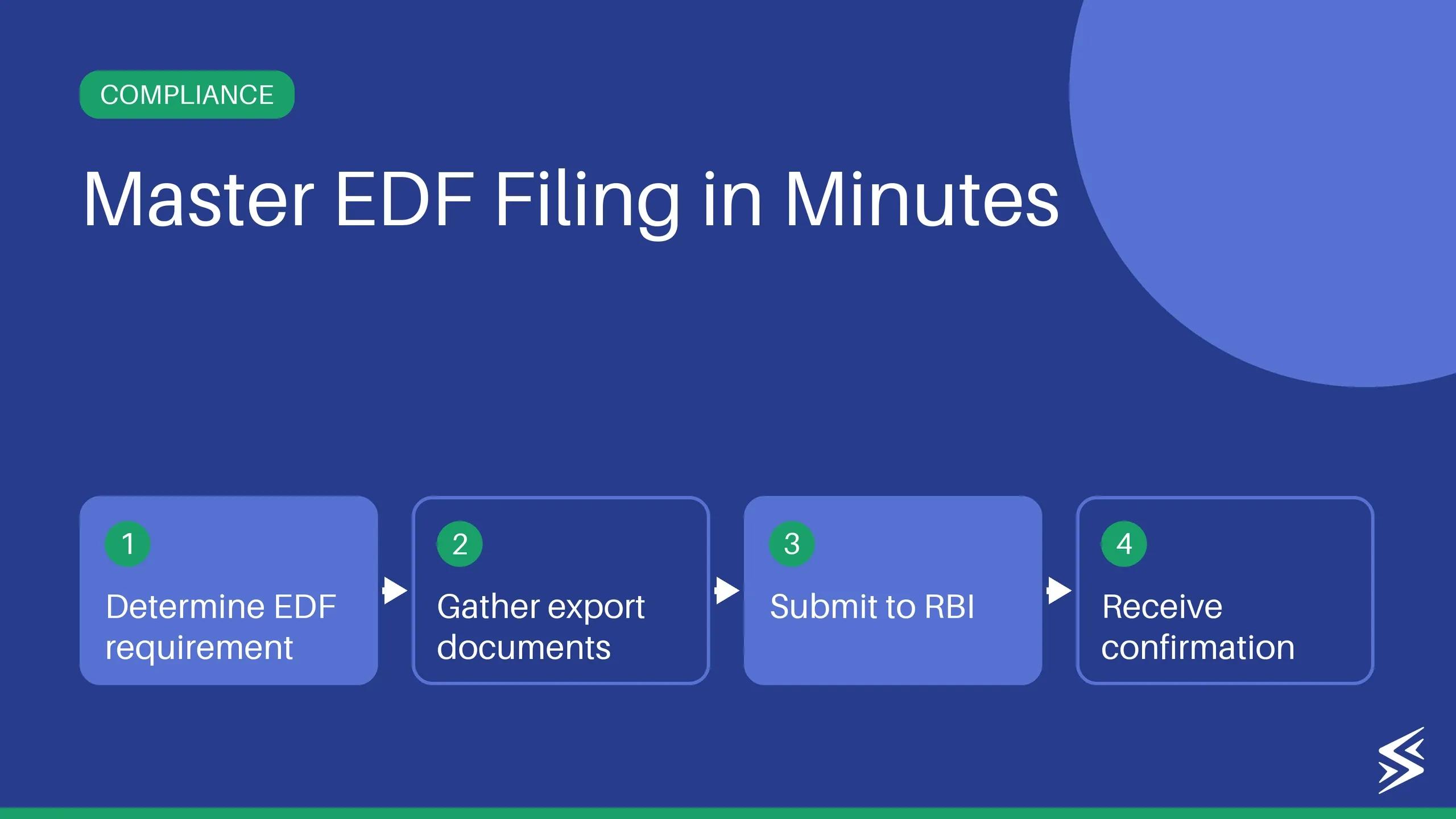
How to file the EDF: A Step-by-step Guide
Goods, major port (EDI)
This is the method most exporters use. The EDF is handled automatically when you file your shipping bill.
- Start by registering your bank's AD code on ICEGATE.
- Then file your shipping bill on ICEGATE, the export declaration form is submitted automatically with it.
- Customs clears your shipment, and an EDPMS entry is created in the system.
- Within 21 days, send your documents to the bank: commercial invoice, packing list, bill of lading,or airway bill.
- When payment arrives, the bank matches it to the EDPMS entry and closes it.
- Once that's done, you can apply for your eBRC on the DGFT portal.
Goods, smaller port (non-EDI)
At non-EDI ports, EDF details may need to be submitted separately instead of being automatically linked through the shipping bill system.
Typically, exporters:
- submit the EDF and shipping documents to customs authorities at the port,
- provide export documents to their Authorised Dealer (AD) bank,
- and work with the bank to track payment realization and closure of the EDPMS entry.
Services (from Oct 2026)
For service exporters, the process is expected to become more structured under the new FEMA 2026 framework, although the operational workflow is still evolving and banks are likely to issue more detailed guidance closer to implementation.
Based on the current regulations, the process will broadly involve:
- maintaining records of export invoices raised during the month,
- preparing a consolidated EDF covering those invoices,
- and submitting the declaration to your AD bank within 30 days from the end of the invoice month.
The bank is then expected to update the export details in EDPMS and close the entry once payment is realized.
Skydo is actively working on an automated EDF closure tool to help exporters manage these requirements with minimal manual effort. Try Skydo
What are Some Common EDF Mistakes and How to Fix Them?
Using the wrong HS code
If the HS code doesn’t match the product being exported, customs can flag the shipment or raise valuation and duty queries. Always verify the latest tariff classification before filing.
Invoice and EDF values don’t match
Mismatch between invoice values and EDF details can lead to bank queries, processing delays, or rejection of export documents. Double-check currency, invoice amount, and export value before submission.
AD code not registered on ICEGATE
If your bank’s AD code is not registered on ICEGATE, shipping bill processing can get blocked. First-time exporters should confirm this setup with their bank in advance.
Delays in document submission
Late submission of export documents can leave EDPMS entries unresolved for longer than necessary. Keeping documentation organized and submitting it promptly helps avoid follow-ups and compliance issues.
Payment received, but EDPMS still open
Sometimes payments are received, but the corresponding EDPMS entry is not updated or closed. Maintain a tracker with invoice numbers, shipping bill details, payment dates, and bank status updates to monitor closures properly.
Service exporters not preparing for EDF compliance
From October 2026, service exporters will come under the EDF reporting framework. Freelancers, agencies, SaaS companies, and other service exporters should start understanding their bank’s expected process well before the regulations take effect.
How Skydo helps with EDF compliance
Once the EDF process is completed, the next step is ensuring export payments are received, documented properly, and matched against the correct export entries for closure. That’s where most exporters end up spending time on manual follow-ups and reconciliation.
Skydo helps simplify that part of the workflow.
With Skydo:
- you get dedicated virtual accounts to collect international payments,
- every inward remittance comes with instant FIRA,
- payment records stay structured and eBRC closure is processed by Skydo,
Skydo is also actively working on automated EDF tracking and EDPMS closure workflows to help exporters manage the upcoming FEMA 2026 compliance requirements with significantly less manual effort.
Want to see what hassle-free export compliance looks like?

Get international bank accounts in 5 mins

Save as much as ₹10 lakh annually with Zero FX Margin

Real time payment tracking and instant FIRA
Get international bank accounts in 5 mins
Save as much as ₹10 lakh annually with Zero FX Margin
Real time payment tracking and instant FIRA
Frequently asked questions
The EDF is a mandatory form you submit to declare the value of goods or services you're exporting from India. It's required under FEMA and creates a tracking entry in RBI's EDPMS system.
About the author

Head of Operations
Leads Payment Operations and Experience at Skydo, building seamless, automated cross-border systems. Previously at McKinsey, P&G, Delhivery, and ShopDeck, with expertise in operations and process optimization.

Verified by
CA Abhilove ShardaLatest blog posts
View all posts
ICEGATE Shipping Bill Status: How to Check & Track? (2026)
HSN Code: Full Form, Meaning & How to Find It?

How to Get US Clients from India: A Practical Guide
Related blog posts
View all postsICEGATE Shipping Bill Status: How to Check & Track? (2026)

RCMC Renewal: Process, Documents, Fees & Validity (2026)